It’s been a while since I wrote an unhinged article, so now feels like a good time to contribute one to the otherwise AI-dominated wasteland that is the modern internet! This time, the focus of my deranged musings is none other than the best/worst deaths of characters in fantasy books. Yep, really. This list is going to cover the most epic, most impactful, most horrific, and most poignant ends that authors of fantasy fiction have delivered for the characters in their charges. You ready?
🚨 It probably goes without saying, but just in case…lots and lots of spoilers ahead! 🚨
Notable deaths in fantasy books
The Heroes – Klige
Starting off this list with one that stuck with me ever since I first read it. Joe Abercrombie’s The Heroes is a genuine work of art. Writing a fantasy novel centred around a single battle feels like an insane thing to even attempt, but it is a genuinely incredible read. Part of what makes it incredible is how pointless it makes all the fighting feel.
And nothing embodies that pointlessness more than poor young Klige, who—along with his new Union comrades—is trekking across a marshy swampland to occupy a more strategic position when he gets stuck in the bog. Unfortunately for him, the initial annoyance at getting his boot stuck in the mud quickly turns to terror. Both the character and his helpless comrades have to watch as he sinks into the quagmire. It’s a sickening sequence, and only a spans a few paragraphs, but I think it perfectly demonstrates the futility of war.
The book itself is absolutely packed with deaths (did I mention the entire story is a single battle?) but nothing left quite the mark on me like Klige.
The Stand (entire interstitial)
The Stand is one of my favourite books by Stephen King. And while there are plenty of notable individual character deaths in the story (Nick, noooo!) there is also an infamous entire chapter that’s worth calling attention to. That chapter is an interstitial away from the main storylines.
The plague has run through American society like wildfire and King then goes on to chronicle the “second wave” of deaths. This is an entire chapter dedicated to little vignettes of characters who meet unfortunate ends, despite having survived the initial deadly sickness.
Being Stephen King, this segue away from the main arc is both bleak and brilliantly written. We meet a woman who unknowingly locks herself in a walk-in freezer, or a child who falls off their bike and cracks their head on the sidewalk. Grisly ends that really help hammer home the scale of the pandemic, and highlights the fragility of life. It makes The Stand even more horrifying, and I’m here for it.
Ravenheart – Jaim Grymauch
I’ve written at length about how much I adore the Rigante series as a whole, and how much Ravenheart, in particular, means to me. Well, a good deal of that is simply down to the emotional damage of Jaim Grymauch’s final scene on the page.
Let there be no doubt, this is David Gemmell at his very best. He introduces us to Grymauch as a roguish scoundrel, flawed but ultimately with a heart of a gold. A ‘man to walk the mountains with’ as Gemmell himself writes. Jaim is larger than life, and his romantic arc with Maev Ring (another of Gemmell’s best characters) is wonderful…and ends in spectacular tragedy.
The setting, the scene, the other characters, the reveal, the fight, the hope of escape…and then the devastating moment. Everything about this death will give you frisson.
The Hunter’s Lament – The Wyn
Speaking of tragedy, if you read The Hunter’s Lament then you’ll know that Sweet and his crew of veteran bounty hunters all have a pretty bad time of it. But the Wyn’s death, in particular, hits harder than others.
Which is strange, when you consider that the character barely speaks, and doesn’t get much by way of a word-count in the rest of the novel. What’s most affecting though, is that the Wyn sacrifices himself in order to protect the rest of the crew. He does it wordlessly, and leaves Sweet himself lamenting all of the missed chances to develop a proper comradeship with the man.
A good example of the impact death has on those left behind.
Red Seas Under Red Skies – Concrete guy
Okay that’s enough about tragedy for the time-being, let’s get back to an impactful moment of grisliness.
The unfortunate character in question here doesn’t even get a name, but the story of his end merits a place on this list because of the purpose it serves in proving a point. The point here being that the villain of the piece, Requin, the owner and proprietor of the tower-based casino known as the Sinspire, is not to be fucked with.
I’ll skim over the details, but suffice it to say that our victim tried to cheat the house and got caught. As punishment, Requin had half of him encased in concrete. One arm, one leg, half his head and body. When the concrete hardened the man was left to rot inside his half-a-prison. He was kept alive for as long as possible, and used as an example that while Requin himself isn’t physically dangerous…he has the power, the time, and the means to be horrifyingly creative when it comes to his enemies.
It later transpires that the whole thing is actually a clever bit of myth-making. A rumour, stoked by Requin to…ahem…cement his fearsome reputation. Either way, a point well made.
Best Served Cold – Benna Murcatto
Yes, another Joe Abercrombie book. This time it’s my favourite from the First Law series, Best Served Cold.
Specifically, it’s the death that kickstarts the entire story. Benna Murcatto is stabbed (once in the neck and once through the heart) and then thrown from a high balcony of a mountain estate/fortress. His older sister, Monzcarro “Monza” Murcatto is half-garrotted before following suit on the long fall down a mountainside. She only survives because she lands on her brother’s corpse, leaving her badly wounded…but alive.
But what is exemplary about how this death is written is the aftershocks of it. Monza, once healed, becomes obsessed with vengeance. Benna’s death changes the fate of entire nations as his sister hacks and slashes her way through those who wronged her. But what’s even more compelling is that we learn more about this character—who dies in the very first chapter of the book—as the story progresses.
We see Benna through Monza’s rose-tinted viewpoint, but slowly learn the truth about who he really was. It’s a brilliant way of questioning perspective and legacy…not to mention a great set-up for a helluva book!
The Lies of Locke Lamora – Calo, Galo, and Bug
Yeah these ones really hurt. I absolutely adore The Gentlemen Bastards sequence, and the opening instalment, The Lies of Locke Lamora, is exceptionally good.
One of its chief draws is the titular group of ragtag thieves and con-artists who serve the thirteenth god, The Gentlemen Bastards themselves. The interplay between Locke, Jean, Calo, Galo, Bug and Father Chains is wonderfully written, and you almost instantly find yourself rooting for this roguish group of underdogs. They are charming, their friendships feel real and fully-formed. It’s great.
Which is what makes three of them getting murdered so brutal. It’s an absolute gut-punch, and it immediately makes you realise that the danger in this story is very real. It makes you wonder if our remaining protagonists are going to make it through. It makes you want them to avenge their friends’ death…with interest.
This is the kind of impact that authors want deaths to have on their readers. It’s spectacular writing.
Druss the Legend – Druss
I pretty much had to finish this list with Druss. The legend from David Gemmell’s debut, Legend.
Druss’ death is pretty much guaranteed by the opening chapter, in which he argues with an ethereal embodiment of Death itself. The spectre offers an already elderly Druss a few decades more of life, or a death in battle at the fortress of Dros Delnoch. Druss, understanding the difference between both existing and living, and standing by your principles, chooses the fortress.
Druss is one of those characters who means so much to so many. He is an old-school fantasy hero, in that he is very binary with his worldview. His “iron code” is often derided as being overly simplistic, but I actually think that—in the modern age—it’s a useful counter-argument to the reams of manosphere-inspired poison that’s out there. It was good enough for thirteen-year old me, and I think it still stands for teenagers (particularly teenage boys) today.
So his death hits hard, even though we knew it was coming. What’s remarkable is how Gemmell manages to give us one final act of defiance from Druss. He is poisoned by a duel with a Nadir warrior who smeared toxins on his weapon, but refuses to die on his sickbed. Mortally sick, the elderly Druss still forces himself to the battlements to defend his homeland.
What’s even more remarkable, though, is what comes afterwards. News of Druss’ death reverberates around the entire fantasy world, and even Ulric—the man leading his armies against Dros Delnoch and a former travelling companion of a younger Druss—stops to pay his respects.
It’s rare that the death of a fictional character can mean so much, but this one really does.
Who did I miss? What deaths in fantasy are so well-written that they made you pause to take stock? Let me know in the comments below!
📚✌🏻SP
Share this post
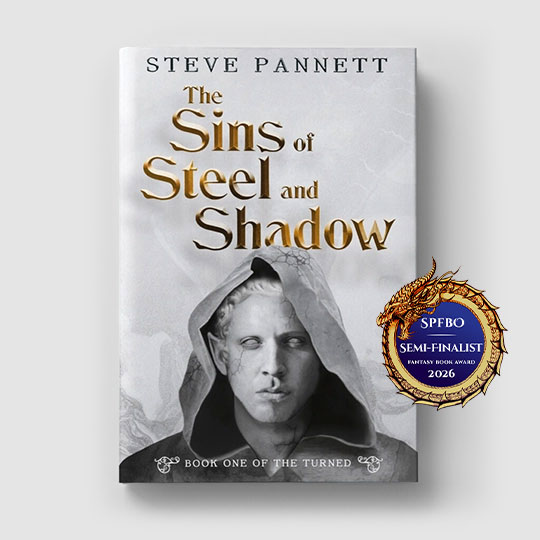
Book One of the TURNED
The Sins of Steel and Shadow
Hated and reviled by humans and vampyrs alike, every day for a Turned is a deadly struggle. But when Bail is offered the chance of a lifetime, there’s much more at stake than just his survival.
The Turned series is a fast-paced, character-led, gritty fantasy saga for fans of Joe Abercrombie or Scott Lynch.

Steve Pannett is an author and designer based in Yorkshire, UK.
He writes primarily in the fantasy genre, combining character-led storytelling with epic, gritty world-building to create dark tales with plenty of action and lots of twists along the way.
He has self-published multiple books and is active online.