Stephen King is undoubtedly one of those authors that I think every reader should at least try to read, even if horror/dark fantasy isn’t really your thing. This is a recommendation based purely on the fact that he is a brilliant storyteller, and I think every reader will get something out of his books. That being said, with a catalogue as broad and deep as King’s – where should you start? Well, here are my five best reads from Stephen King.
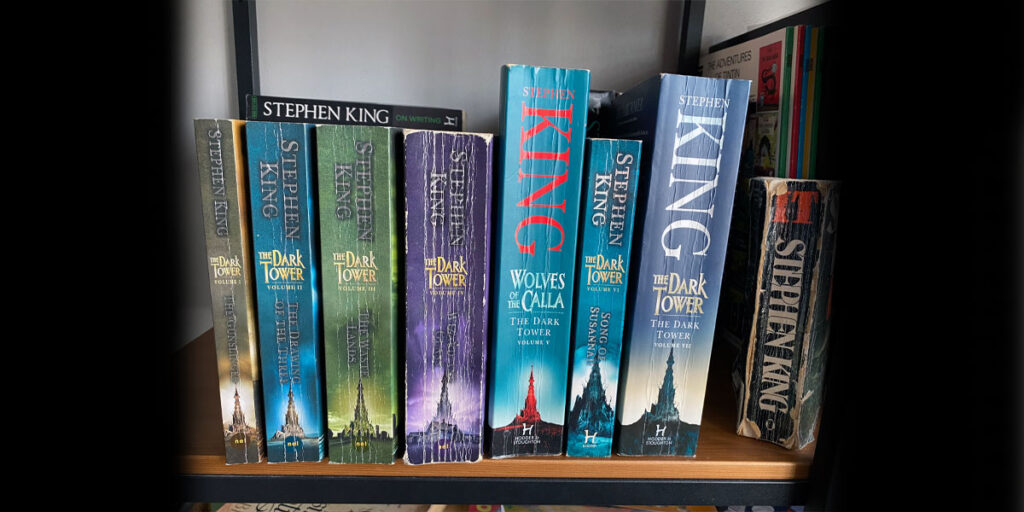
The Dark Tower series
Ok, yes, I’m starting with an absolute cheat code. Because The Dark Tower series isn’t just one book, it’s seven. It’s also a huge undertaking, as it clocks in at well over 4,500 pages (depending on which printed edition you go by) – so it’s not exactly a small reading commitment. But I wanted to get it in first anyway, because I firmly believe that it is absolutely worth reading (from start to finish) at least once.
Let me be completely clear. I don’t think this is Stephen King’s best work—and by quite some distance, too. It is however, so epic and grandiose that it should be on every reader’s bucket list. Defining it isn’t easy. It’s modern fantasy meets spaghetti western meets post-apocalyptic horror meets thriller meets tension-building mayhem. I’m seriously not sure I can do much better than that. Just read it!

IT
One of King’s most famous/infamous books. The story of how the eponymous “IT” terrorises the town of Derry is a terrifying one. This is definitely one for the horror fans out there.
The book is split between two timelines. In the late 1950s we’re introduced to our intrepid band of misfit children who go on to form The Losers Club. As well as facing the challenges of their approaching teenage years, they’re also living with the fear of other children vanishing in their little hometown. The missing kids have, in fact, fallen prey to an ancient, trans-dimensional entity (IT). A creature that wakes to feast every 27 years. The second timeline takes place in the 1980s, where our protagonists learn that the past doesn’t always stay in the past…
I’ve seen a lot of people complain that this book is too long, and while I can understand that view, I also disagree with it. For me, every scene adds to the foreboding sense of terror that builds throughout the book, reaching a double-timeline climax at just the right point in your reading journey.
The other criticism of this book is more warranted, as it features a somewhat infamous scene that takes place in the sewers at the end of the story. It’s problematic because I don’t think it can be argued that that particular scene is absolutely necessary (certainly not in the way it’s written) but I also don’t believe that—as I’ve seen some people suggest—it somehow promotes or endorses anything untoward. It’s just a bad scene in an otherwise brilliant book.

The Long Walk
One of the ‘Bachman books’ (stories that King published under the pseudonym of Richard Bachman) The Long Walk is more of a novella than a full-length book, which is why I recommend it to people who haven’t read much/any of Stephen King before. It’s short, but it will grip you.
The story follows a dystopian reality show, in which 100 contestants can enter the titular game of The Long Walk. The competition has no finish line, as competitors are simply made to walk (above a set speed) until there is only one left in the running walking. How do they drop out, you ask? Well, in true Stephen King style, the walkers are all accompanied by armed guards on a half-track truck. When a walker falls below a certain speed they are issued with a warning. Get too many warnings and…bang. One less walker in the competition.
It’s a devastatingly simple premise, but what I love about this book is the psychological turmoil you will endure as a reader. You ride walk along with a group of characters who—despite knowing that only one of them can win, and therefore live—still bond together in their desperate predicament. They share their hopes and dreams with each other. Their problems and fears, too. And they develop a shared hatred of the blank-faced guards charged with delivering their warnings—and their executions. They go through a rollercoaster of emotions when it comes to the crowds who gather to watch and bet on the competition itself. It’s a raw and close-up examination of the human condition.
What’s more, despite being so self-contained as a story, it still manages to deliver one hell of a twist at the end!

The Shining / Doctor Sleep
Another cheat code, sorry! Yes, these are two books that I’m lumping together, but I just love how much they work together (despite being written some thirty years apart).
If you didn’t already know, The Shining follows the story of the Torrance family. Jack is an alcoholic writer who takes the job as the winter caretaker for the ominious Overlook Hotel. His wife Wendy is trying to support him through a difficult period of his life, but is worried for the safety of her son, Danny, who exhibits an ability to sense things and communicate telepathically (a talent dubbed his “shining”). Unbeknownst to the family (but sensed by Danny) The Overlook Hotel is a site of supernatural power, and has a dark history that is revealed as the family are snowed in alone for the winter. As the book progresses, we see Jack’s mental state unravel as the hotel exerts more and more malevolent influence over him, culminating in it ordering him to kill his family and then himself.
The Shining is a bonafide horror classic, and even if you stop after reading it, I think you’ll be better for the experience of doing so. But, the sequel, Doctor Sleep is—in this writer’s opinion—just as good. Perhaps even better.
Doctor Sleep was King’s response to the question “what happened to Danny?” after the events of The Shining. His response was to show how history repeats itself, with Danny growing up to be a selfish, alcoholic drifter. He eventually finds refuge working in a hospice, using his “shine” (which is returning now that he’s stopped drinking) to help patients as they pass over into death. Meanwhile, we’re introduced to what I think are some of King’s greatest ever villains: The True Knot.
The True Knot are a cult of vampyric-like beings who feed on the “shine” of adept children. Specifically, they get the most out of that shine when those children die in great pain and terror. That makes them horrifying. What’s more, the True Knot can pass for regular people. They travel in a convoy of RVs across the continental United States, seeking out their next victims before simply packing up their trailers and moving on again. They wear Hawaiian shirts, bucket hats and novelty sunglasses. They are, to the unobserving eye, just “RV people” – folks you can see on any highway in America. That makes them even more terrifying.
Doctor Sleep feels better paced than The Shining, which is more of a slow-burn book, but the villains are what steal the show. It was also made into a brilliant movie adaptation, starring Ewan McGregor as an adult Danny Torrance and Rebecca Ferguson as Rose the Hat, the leader of the True Knot. Both actors truly delivered in those roles, and—in my opinion—even matched Jack Nicholson’s iconic portrayal of Jack Torrance in Stanley Kubrick’s adaptation of The Shining.
Read both books, I promise you’ll thank me.

The Stand
This is my favourite Stephen King novel. It’s also an absolute doorstop of a book, so if you’re just looking to test the waters you should refer to an earlier part of this post and pick up The Long Walk instead. The vibes of both books are similar, but The Stand is simply epic in scale and ambition.
Here’s the premise: an accident on a military base results in the release of a deadly bioweapon. A weapon that, over the course of just a month, kills approximately 99.4% of the world’s population. Reading that unfold, from the perspective of a host of great characters, is horrifying enough…but then there’s what comes next.
After the near-complete destruction of the human race, the survivors begin banding together in two groups. They’re drawn together by strange visions and dreams that they have as they try to survive in the post-apocalyptic USA. These groups are headed by the down-to-earth-but-saint-like Mother Abigail, and the dreaded “dark man” – Randall Flagg. The supernatural element here is pretty straightforward to understand: God and the devil are warring over the few souls that remain on Earth.
This book is bleak and it’s dark (one chapter in particular describes a spate of “second” deaths that befall survivors of the initial plague) but it is also brilliant. The characters you travel with are incredibly well written. They’re nuanced and human, exhibiting both good and bad qualities throughout. The action sequences will leave you somehow wide-eyed and grimacing at the same time. The dialogue is—as it always is with King—sharp as hell. Everything about this book is just perfect.
Even the ending, which—after such an epic journey—is one helluva way to finish a book.
In conclusion
I had to trim this list down to just five books in order to make it bearable as a guide. But the simple truth is I could’ve written two, maybe three more lists and still have hit the mark. Don’t get me wrong, I think Stephen King has written some bad books (I don’t like Carrie, Bag of Bones, or Cujo – the latter of which always gets a small gasp when I admit that) but I think he is, overall, an absolute must-read for everyone who enjoys great storytelling.
📚✌🏻SP
Share this post
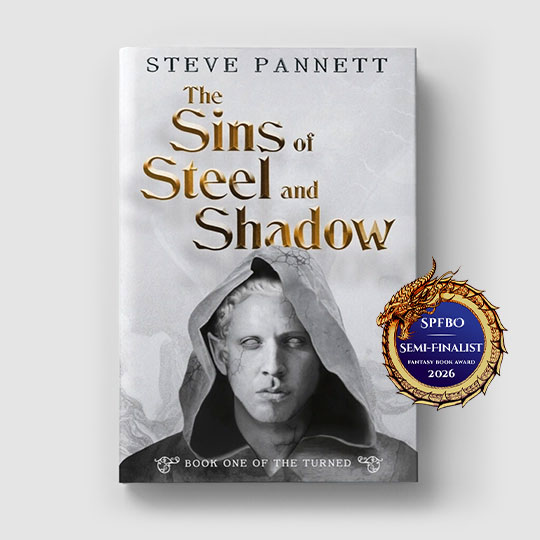
Book One of the TURNED
The Sins of Steel and Shadow
Hated and reviled by humans and vampyrs alike, every day for a Turned is a deadly struggle. But when Bail is offered the chance of a lifetime, there’s much more at stake than just his survival.
The Turned series is a fast-paced, character-led, gritty fantasy saga for fans of Joe Abercrombie or Scott Lynch.

Steve Pannett is an author and designer based in Yorkshire, UK.
He writes primarily in the fantasy genre, combining character-led storytelling with epic, gritty world-building to create dark tales with plenty of action and lots of twists along the way.
He has self-published multiple books and is active online.