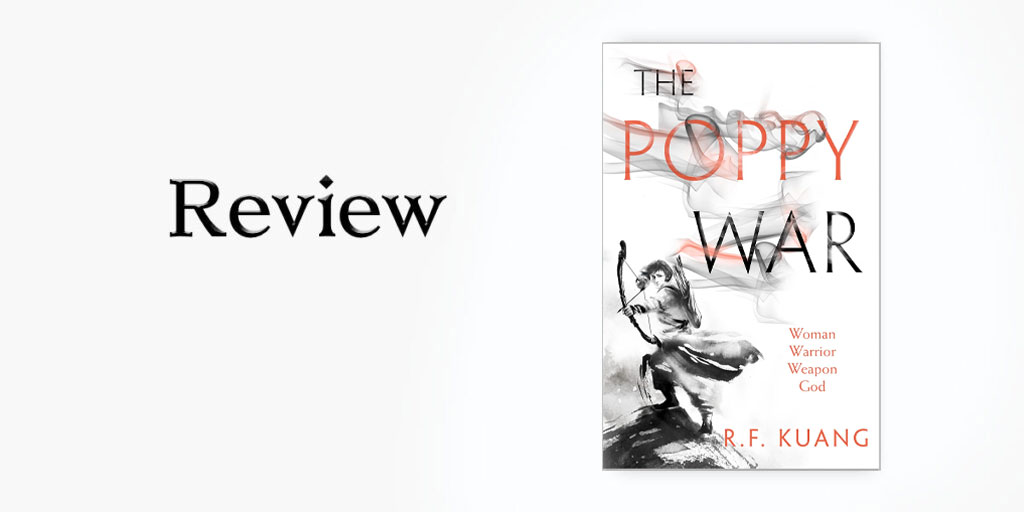
I read R.F. Kuang’s The Poppy War in just over a week, after seeing it recommended over and over again by folks who—like me—enjoy their fantasy books with some darkness and grit to them. Here’s my review of my experience with the story.
Before we begin
I have to start by acknowledging that this post will likely break a cardinal rule of my blog. Specifically, I tend to only review books that I enjoyed reading. That alone should tell you something about where this review is heading, but I wanted to flag it because it’s important to me. I’m an author myself, as well as a reader, so reviewing the work of people who I see as peers comes with some additional baggage. That’s why I have the aforementioned rule.
Normally, if I finish a book (or DNF it partway through) and I haven’t enjoyed it…I just won’t say anything about it (except maybe in private conversations with people close to me). But with The Poppy War, I was so conflicted by my experience that I felt like I had to write this review. Plus, I’m not arrogant enough to assume that my opinion alone could have a detrimental impact on a book that has already enjoyed huge levels of success! If this was a less well-known book, with fewer reviews or words penned about it…I might not have written this article. Anyway, enough about me. Let’s get into it.
The premise
The Poppy War is—broadly speaking—a fantasy retelling of early-mid 20th Century Chinese and Japanese history. We are introduced to various countries and factions, all of whom very closely resemble geopolitical players of the time. Names and details are changed, but to call the period just an “inspiration” for the book falls too short, in my opinion.
Now, if you have a cursory understanding of the real-world history for that time/place…you’ll see immediately why this book is discussed as being bleak, dark, grimdark etc etc. For full disclosure, I knew very little going into the book itself, other than that there were horrors and atrocities carried out that my education barely even mentioned, let alone covered in much detail (I went to school in England during the 1990s/early-aughts, FYI).
The story centres around Rin (full name Fang Runin), a war orphan who tests her way into a prestigious military academy in order to avoid being sold into an arranged marriage. Once there, she is forced to compete with her fellow students—the overwhelming majority of whom are the children of nobility—and train across an array of subjects, including some of the more mystical/fantastical ilk that tips this book into the fantasy category. There is a pantheon of gods, shamanism, the ability to summon monsters and wield fire…all of the ingredients of a fantasy novel!
As Rin is gaining her hard-won education, a war breaks out and she—along with her classmates and teachers—are forced into defending their homeland.
The review
Right then, I’ll tackle this bit chronologically. In fact it’s probably best if I take you on my reading journey, before delivering my final verdict at the end of this piece.
After the first few chapters, I thought that I had made an error in picking up The Poppy War. It was sold to me as a gritty, grimdark masterpiece and while the opening gambit (Rin’s life as the adopted child of small-town heroin dealers) ticks that box, the arc felt decidedly familiar in it’s coming-of-age style approach. This was then exacerbated by the fact that our main character then winds up top of the class in a supposedly impossible test, allowing her to escape a life of misery and enter into the prestigious Sinegard academy!
At this point, I was feeling a bit cheated. The book read more like an edgy Harry Potter story and I was disappointed. My disappointment was compounded by the fact that the next part of the story almost exclusively info-dumped the world-building via history lessons that take place in the book! Now, I really don’t like laying too much criticism on other authors (see my cardinal rule at the start of this post) but suffice to say I am not a fan of this approach to world-building. It feels clunky and heavy-handed, at best.
That being said, the writing itself—outside of the info-dumps—was sharp! Rin was an interesting character—albeit with a fair amount of ‘chosen one’ energy about her—and I was introduced to others along the way that I enjoyed spending time with more, if I’m honest. The sharpness of that writing is pretty much the only thing that kept me from DNFing this book. And, if I’m being brutally honest, I kinda wish I had put it down at this point.
What happens next is the reading equivalent of whiplash in the middle of a handbrake turn made on the corner of a rollercoaster.
The book doesn’t just switch gears, it moves into an entirely different vehicle altogether. Part 1 just sort of…ends, and then Part 2 throws us ahead in a two year time jump. During that time, character relationships have supposedly developed…but—importantly—they’re just not believable. In the space of just a few pages we go from characters barely knowing one another to them having a shared history together. I just didn’t feel those bonds, or animosities, at all.
The pace also increases wildly, too. In Part 1 the book was moving along at a solid lope, but Part 2 starts at a lung-bursting sprint and it felt jarring. As a reader, I couldn’t comfortably reconcile any of this. The writing was still, for the most part, well-crafted, but my struggles had just been compounded as it felt like I was reading a different book entirely.
Because of this sudden new pace, Part 2 very quickly leads into Part 3. Open war—the threat of which was hinted at throughout the story—has broken out between Nikara and Mugen, with the latter launching an invasion that calls every student and teacher of the academy into service. Part 3 sees our protagonist, Rin, forced into working as part of an elite team of outcasts, all of whom dabbled with shamanism and are therefore shunned by polite society. They’re also, thanks to the aforementioned dabbling, all losing their minds. For her part, Rin calls upon her chosen god (the Phoenix) and nearly incinerates everything while trying to defend herself while fighting a Mugen general.
We’re firmly into gritty fantasy territory by this point. We spend time with Rin, her elite team (the Cike), and other characters as they defend a besieged city from wave after wave of Mugen attacks. The fighting is bloody and brutal, ending in a chemical attack that will make your chest and throat feel funny after reading. This part of the story is so wildly different to how the book begins that I can’t properly articulate how bizarre a reading experience this was.
The book then hits the real depths of its bleakness when our characters realise that they have been deceived, and Mugen has sent armies elsewhere. They arrive too late, finding a city that has become the site of a massacre. And, let me tell you now, this is where the author really flexes her writing muscles. She holds back absolutely nothing when it comes to painting a picture of this scene (based on the accounts we have of its real-world equivalent).
It is visceral, it is dark, it is brutal to read. At no point did I feel like any of this was written to be “edgy” and for that, R.F. Kuang should be commended. Too often with outright grimdark books, I get the sense that the writer is just trying to up the ante when it comes to how gruesome or grotesque they can get. This is not the case in The Poppy War. It makes for incredibly uncomfortable reading, and that is exactly how it should be.
Following this utter bleakness…is more bleakness! From here the book only gets darker, ending—inevitably—by evoking what must be considered one of the darkest chapters of real human history. I don’t want to spoil any more than I have already, but let’s just say it’s not a happy ending and the strongest emotion I had was relief that I had finished with the book.
Conclusion
That last sentence I wrote feels very barbed, but I didn’t mean for it to be. I am truly glad that I read The Poppy War, but I will not be recommending it to other readers. I actually think there is an incredible story in there, but there were too many things that—for me—let it down massively.
Firstly, the structure of the book was too jarring. The pace quickened way too much and, after the midway mark, it felt like the story started shaking itself apart because it was moving too fast.
Secondly, the character work felt flat. I never bought into Rin’s internal struggle between weaponising herself or staying on the moral side of good (it seems to me that she never really had much morality to begin with) and I really disliked her (second) supposed mentor, Altan Trengsin. For a character who was supposed to be pivotal in shaping our protagonist, he felt wooden and one-dimensional. And none of the relationships between any of these characters felt real. The text tells us how those relationships should be, but nothing actually shows them developing in that way. By the end of the book, I didn’t particularly care about anyone involved.
The stylistic choices were less of a deal-breaker for me. Now that I’ve had some time to reflect, I can actually see the cleverness in starting a book with an almost YA thread to it, only to brutally strip all of that away and reveal that—in reality—life can be exceedingly painful, bleak, dark and grim. In theory, I like the idea of doing that. In practice, I’m not so sure the approach paid off.
All of this isn’t to say there are no positives from me! There absolutely are! As I’ve noted before, the writing itself is slick and well-crafted. The dialogue, which I covet the most, is strong—although there are one or two exchanges that felt a bit out of place and broke my immersion in the story. The world-building is fascinating, but the mechanism of introducing it (via teachers talking about it to the main character) let it down. Overall, I can see why other readers like this book, but I won’t be continuing with the series.
I do want to end on this, though. This has been a tricky review to write, because it feels decidedly negative and that is not my intention. But I want to end on a positive note, and here it is: no matter what anyone thinks of The Poppy War—and I have seen that it splits opinion quite starkly—not a single reader who has followed Rin’s journey can honestly say that they were ever bored by this book.
It is, in my opinion, many things…but boring is most definitely not one of them.
📚✌🏻SP
Share this post
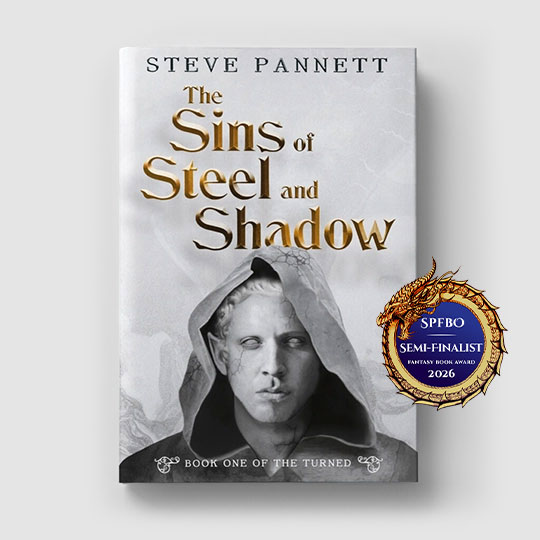
Book One of the TURNED
The Sins of Steel and Shadow
Hated and reviled by humans and vampyrs alike, every day for a Turned is a deadly struggle. But when Bail is offered the chance of a lifetime, there’s much more at stake than just his survival.
The Turned series is a fast-paced, character-led, gritty fantasy saga for fans of Joe Abercrombie or Scott Lynch.

Steve Pannett is an author and designer based in Yorkshire, UK.
He writes primarily in the fantasy genre, combining character-led storytelling with epic, gritty world-building to create dark tales with plenty of action and lots of twists along the way.
He has self-published multiple books and is active online.