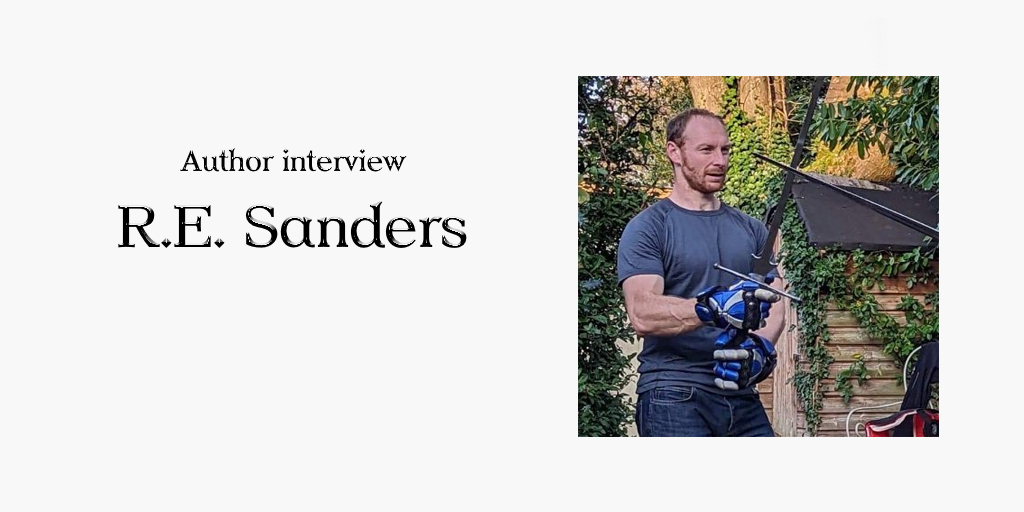
As part of an ongoing series of posts, I sat down for a (virtual) meeting with another indie author in the fantasy genre. Here’s how my chat with R.E. Sanders went.
The interview
Introductions and on reading
Steve Pannett (SP): Hi Rob, great to meet you. Would you like to start by introducing yourself a little bit?
R.E. Sanders (RES): Of course, I’m Rob Sanders, I write as R.E. Sanders. I’m an independent fantasy author from the UK. I live in Wales. I’m not Welsh, but I’ve made Wales and Cardiff my home for the last 25 years. I can’t imagine living anywhere else now…it’s part of my psyche really.
I’ve published four books to date. I sort of eased myself into it. First, I published a novella which is called Tann’s Last Stand, which is a fun little western-themed fantasy book. It’s very much a Seven Samurai type story. I think I watched one of the movies and thought this would be cool if it was fantasy. So, it was a good way to get into writing. I wanted to write. I had ideas about writing, but I wasn’t sure I could pull off a whole book back then.
So that was a nice way to start. And then from that book, another idea spun out which eventually became my debut novel, A Path of Blades. It’s a low-stakes story, almost a family drama rather than a big fantasy. Lots of emotional moments, some sword fighting, but a smaller book. Then after that I felt I was ready to start the series that I had planned, which is called The Jantakai Saga. So far, I’ve published two books of that.
The first one is Demon’s Tear, that came out in 2023. And the follow-up, Demon’s Rise came out in 2025.
SP: Ok cool. So it sounds like, with writing, you worked your way up through the gears a little? Started with a novella, then moved to a self-contained novel, then a series. Not that any of them are easy, mind you! Tell me a little about your debut novel, The Path of Blades, as I feel like I see that one pop up quite regularly online!
RES: I don’t really know where it came from! The story and the characters sort of grew as I started writing. Again, I thought it was probably going to be another novella, in terms of its length. It actually ended up being double that! And it’s not huge battles, it’s not massive magical forces. It’s one guy, one family, really, just trying to keep everything together when there are forces trying to bring them down, essentially. It’s the main character just trying to survive while everything is going wrong. I suppose it’s kind of like a disaster movie, really.
SP: Ace, it’s been sat on my TBR for too long so this is my wake-up call to get into it! I want to dig into your writing process in a bit more detail soon—because I always find there are some great parallels with my own experience, but also so much variation to how I work—but first let’s talk about reading. What’s your earliest reading memory, and then can you take me through your reading journey from there?
RES: Sure. I’ve been such a voracious reader for so long that I can’t really remember when I first fell in love with books. But I remember being one of the first readers in my class at school. I remember whipping through things like Dick King Smith and Roald Dahl, those sort of children’s books — and I read nearly all of them. We had a shelf full of books at home and I just went through them all and then I think it was my Dad’s suggestion to give me his copy of The Fellowship of the Ring to take away when I went on a French exchange, which must have been when I was 13, I guess. And that was it…as it is when you read The Lord of the Rings for the first time.
SP: It’s a real “awakening” moment for so many, right?
RES: Absolutely, I was like, “my god, there’s this whole world.” And so obviously I read the rest of The Lord of the Rings and loved it. And then—I think probably you’ll see some parallels here—I found David Gemmell, I found Peter Morwood, I found David Eddings, Adrian Tchaikovsky, and others a bit later.
And I didn’t quite realise the way that I’d absorbed those influences until readers started saying “your writing is a bit like talking. It’s snappy and fast-paced.” And then I reread Legend by David Gemmell and I realised that this is what I’m writing. This is exactly the way I try to phrase my book, try to show my characters, try to show the action. I think I drew a lot more from David Gemmell’s books than I first realised.
SP: I mean it’ll come as no surprise that I am huge fan of David Gemmell. And yeah just that same thing is what got me hooked, they’re not just stories they’re page-turner stories.
I mean I’ve waxed lyrical about David Gemmell to anyone who will listen, but from another person’s perspective, what is it about his writing, in your opinion, that is just so good?
RES: I think it’s the simplicity with which he writes. He doesn’t make anything flowery. He doesn’t try to impress you with his prose. He doesn’t try to beat you over the head with the characterisation. He just shows it all. The settings he describes…I can see them. He doesn’t go into great detail describing things, but I can see them!
And I can imagine being in the presence of some of those characters. I can imagine them being people I would meet. Whereas you look at a Tolkien character and they’re very remote. It’s hard to imagine bumping into Aragorn, son of Arathorn, in the pub…whereas you can imagine meeting someone like Druss!
SP: I agree with all of that. And when you combine it all, you get a storyteller who is captivating, and I think that’s the real magic ingredient. The thing that separates great writers from good writers. The ability to captivate.
RES: Yeah, I feel the same way about Bernard Cornwell, but with historical fiction. Now that I’m an author, I read differently. I’m much more critical of what I read. I spend my time reading and I think more wisely about where to spend it. If I’ve had a long day, or even a half a day, spent writing, I read a chapter and then I’m gone. But when I pick up a Bernard Cornwell book, I forget that I’m an author.
I don’t know what his trick is. I can’t work it out. I just whip through his books in a way that is just pure consumption of the story and the characters. I picked up one of the Sharpe books recently, a title right in the middle of a series—I didn’t care. I just didn’t want to do anything else for two days until I’d finished it.
SP: The sign of a great book.
RES: The sign of a great book.

On writing
SP: Ok wonderful. So now tell me about the transition from reading into writing. When did you first think “I’m going to give this a go myself”?
RES: So that goes almost as far back as reading, actually. I remember at primary school, all I wanted to do was write stories. If the teacher gave me the opportunity to write a little story then I would. I remember making a little book of stories about animals—obviously I’d been reading the Dick King Smith books—so I wrote a book and I got it stapled so that it folded in half, just like a real book…and I was so proud of that!
SP: I have twin boys. They’re seven years old and they love doing this exact same thing. We have boxes and boxes of their homemade stories in our house. I think it’s such a gateaway into a love of both consuming and creating the written word. Love it!
RES: Yes! And I remember again through secondary school if I got the opportunity to write creatively, I’d take it. I think I was doing my English GCSE and we’d be doing all this boring coursework about linguistics and stuff and then the teacher said, “if you want to, you can hand in a bit creative writing as your coursework” — and I came in the next day with a story.
And then the idea for a fantasy novel came from there, I guess it’d always been going around in my head because it’s a genre I love. It was always there and I started writing the very first draft of what would become Demon’s Tear in my 20s. I wrote about half a novel’s worth and then for one reason or another, life intervened. I think I probably got bit of imposter syndrome. So I stepped away from it for about 20 years. It just sort of sat there.
In the meantime, I still tried writing. I did a bit of non-fiction. I published various things online. I wrote a bit about sport. I’d write match reports if I was in a club or something. And then when Covid came around I isolated myself. I’ve got an attic room and I stuck myself up there so I didn’t infect my family before Christmas. When I was up there I just thought “well what I’m I going to do now?” and I had loads of old folders on my computer. So when I started opening them and flicking through it, I saw that book.
And so I read it, expecting it to be horrifyingly bad. And I was like, “Actually…it isn’t any good, but I do like the ideas. I like the characters I’ve created. I should do this. I should get back and knuckle down on this.”
It felt like I had the time to do it. I could chisel out a little bit of time in my day. I felt I had the life experience to give characters a bit more weight than maybe I would have done in my 20s, too. So yeah, that was the plan.
SP: And what do you think is the most important thing, or the most important trait, that you need to follow through with that? Because I hear all the time from people who tell me they want to write a book, but they either find it too daunting to start, or they start and then get cold feet.
RES: It’s the confidence that’s the biggest stumbling block. People give you practical, functional reasons why they don’t start, or why they stop. But from listening to everyone and thinking about my own experiences, generally the reason why you stop writing something is because you don’t have confidence in it. You feel it’s not good enough. So you think what’s the point?
You’ve got to be so motivated to write a novel.
I don’t think it’s really appreciated just how motivated you have to be, sometimes. You’ve got to get up and write, day after day after day. Maybe not consecutive days, but you’re probably going to be looking at 6 months to a year. I write part-time. I can’t write full-time, so a novel takes me about a year. So for that dedication, you need the confidence that what you’re doing is worth it.
And then some people will write maybe 20,000 words and go, “I really need to get someone to look at this now.” And they’ll send it out to someone, one of their friends maybe, and their friend will come back with some thoughts. Either they’ll say, “this is great.”
Or the friend will think “they’ve asked me to critique it, so I need to critique it.” …and that new writer is not ready to receive critique.
They’re just not ready. They don’t have the confidence in the story. They don’t have confidence in themselves. They’ve got this partly-written thing in its rawest form, and all the critique does is make them doubt everything they’ve done. Any knock to your confidence just puts you back to square one.
I think what you really need to do—and this is something Stephen King says in his book On Writing—finish it with a closed door. Reread it and edit it with a closed door. Don’t let anybody see it until you’re ready.
SP: I love On Writing, and I fully subscribe to that advice, too. What about when you’re ready to open the door, what does your personal approach to editing passes look like?
RES: So I actually work in a bit different way to you—and probably most people, actually—in that my first draft written by hand.
So I use A4 notebooks. I get the same brand of notebook and I sit and write by hand and then when I’m good and ready, I will start typing.
So by the time I’ve typed it up, I’ve already done one pass. And at that point, it normally also flags up any major issues that I’ve got in my first draft. I can fix these at this point. Which means that the very first typed draft of my work is usually pretty clean.
My first written draft is a bloody mess! My handwriting is terrible anyway and it’s just got scribbles and notes that say stuff like change this or Rob, look this up and that kind of thing, but the first typed draft is in much better shape.
SP: And when you write your stories, do you have a plan for them? Or do you just freestyle it?
RES: If a book’s 100,000 words long, that’s roughly 300 pages. There’s no way you can know—before you start writing it—every twist and turn right up until the end. You can’t plan that far in advance because you just don’t know exactly what is going to fall out of each scene. That’s the way I feel, anyway.
The analogy I would think of is that it’s like going on a long car journey.
So, you know your house, you know the turn onto the main road, and you know the way you’re going to leave the motorway…but then a bit beyond that—your destination—you don’t think about that just yet. You don’t know each direction or notice any landmarks until you’re closer to them. So, that’s the way I write. I know in pretty good detail what’s happening in the next five chapters. The next ten chapters further on are a bit hazy. The next 20 chapters, even hazier.
I know where the destination is. I don’t know exactly how I’m going to get to it.

On publishing
SP: That’s a great analogy. Let’s move onto publishing now. Was it always your intention to publish your work, or did that thought come after you’d written your novella?
RES: My intention from the start has always been to put stuff out there.
Even from the very early stages of writing those little non-fiction articles, I’ve always found someone who wanted to publish it on their website or whatever. I’ve never been shy of that, really. And yeah, I don’t think I could be motivated to write something as big as the books that I write without feeling that there would be some sort of audience for them.
But it was only once I’d actually come back to writing and had written my novella that I really discovered the way that self-publishing worked.
But I quickly figured out two things. Firstly was that I don’t think the way the trad-pub market for fantasy works at the moment would work for my writing. It’s a bit older in terms of style, similar to those authors from the 90s. That’s what I love. And I do think there’s an audience for it, but the current traditional publishers don’t love it. It’s not a big marquee seller for them, so I never felt like that was going to be a fit.
And equally, I recognised that if I self-publish then I’ve got complete control of what I do. I can publish on my own schedule and I can get my own cover design. I can do whatever I want with the inners. I really am my own master.
SP: I’ve just written an article about the different routes to publication and you’ve just hit on some of the key points there in terms of having that control and also having the understanding of what the current market looks like before you start firing queries all over the place! I think that’s a definite skill set that most new authors need to learn; that there will be an audience for your book—because there’s an audience for every book, as far as I’m concerned—but that doesn’t mean it will be commercially viable for trad publishers to take on your work. It’s not personal, and it might not even be an invalidation of your writing, it’s a business and should be viewed through that lens.
RES: Yeah exactly.
SP: And do you treat your own self-publishing like a business? I know from my own personal experience that I take it seriously, but I’m very protective of my own enjoyment, too. Basically, I take my writing seriously, but if I treated it too much like a job then I worry that I’d fall out of love with doing it!
RES: So, more and more, I have been treating it as a hobby…with the bonus that it occasionally sells books. Because I think to set my expectations to anything else would just lead to disappointment and frustration. The other part of that is that it’s such a noisy market. There are a million other books out there so it’s really hard to market your own in such a crowded space.
SP: 100% agree. And, speaking as someone who works adjacent to marketing/digital marketing, it’s only getting more difficult!
RES: And it feels like there’s a whole industry growing around trying to make money off of self-published authors.
SP: Including a lot of people who aren’t necessary qualified to help. Maybe even some bad actors, or just outright scams.
RES: Yes, and I think you need to be careful. I know of some indie authors who invest thousands and thousands of pounds and struggle to break even. But then, I also know of an author who self-published a title about the same time as I did and they had a viral moment on TikTok, with the rest of the series ready to go. Sales went through the roof! It was great!
SP: And I think this is perhaps where I take a great deal of heart from the current landscape, because actually those moments can happen, but only if you’re persistent enough and have the self-belief—it’s going back to your point on confidence—in your books. And, actually, there’s an argument to be made that if it takes a bit longer then that will work in your favour! Not only will you have more experience and know-how, but you’ll also—hopefully—have a bigger back catalogue for readers to discover!
RES: Yeah that’s a good point. But to answer your original question, I can’t imagine what I’d do with my brain if I wasn’t thinking about books and writing books. So I’m not going to stop…unless someone physically makes me put the pen down!
SP: Yes! Always for the love of the stories! What about the future then, what’s on the horizon for R.E. Sanders?
RES: So I’m continuing with The Jantakai Saga, and I’d encourage readers to pick up Demon’s Tear first, of course. I’m also contributing to an anthology called The Rings of Adventure, which has been fully-funded on Kickstarter but you can still late-back it.
SP: Exciting times ahead! Rob, it’s been a pleasure. Thank you for talking with me today.
RES: My pleasure, thank you.
My thanks to Rob for sitting down to talk to me. If you’re an author who wants to talk reading, writing, and all things books, please fill out this form.
R.E. Sanders is the author of The Jantaki Saga, the standalone novel A Path of Blades and the novella, Tann’s Last Stand. He has also contributed to the upcoming anthology The Rings of Adventure.
📚✌🏻SP
Share this post
Book One of the TURNED
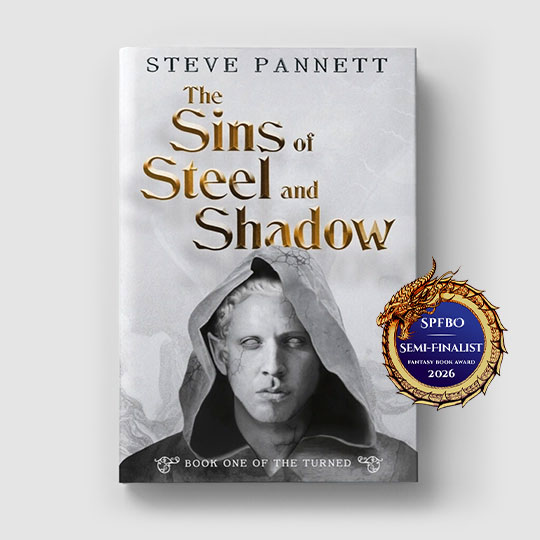
The Sins of Steel and Shadow
Hated and reviled by humans and vampyrs alike, every day for a Turned is a deadly struggle. But when Bail is offered the chance of a lifetime, there’s much more at stake than just his survival.
The Turned series is a fast-paced, character-led, gritty fantasy saga for fans of Joe Abercrombie or Scott Lynch.

Steve Pannett is an author and designer based in Yorkshire, UK.
He writes primarily in the fantasy genre, combining character-led storytelling with epic, gritty world-building to create dark tales with plenty of action and lots of twists along the way.
He has self-published multiple books and is active online.