David Gemmell is one of my favourite authors. He’s one of the authors who I credit with first getting me into the fantasy genre. And, of his extensive catalogue, the Rigante series are easily some of his best (I’d even go so far as to say they’re the best Gaelic-inspired fantasy books ever written). So it’s safe to say this article is going to be a glowing one. Here’s my review of Sword in the Storm, by David Gemmell.
My reviews of the other books in the Rigante series:
- Midnight Falcon review (Book 2 of the Rigante)
- Ravenheart (Book 3 of the Rigante)
- Stormrider (Book 4 of the Rigante)
The review
Sword in the Storm starts with what feels like a fairly familiar pattern. Our main character is Connavar, a teenager in the Rigante tribe whose soulname also provides the title to the book. He is—as most teenage boys are—sure of his immortality and importance in the world. At first, this feels very much like a “coming-of-age” fantasy story.
And it is, but not in the ways you might expect, given how much of the genre follows a fairly similar pattern. Connavar is put through plenty of early trials. But rather than them shaping him into the archetypal hero of the story (typical of this kind of trope) what we actually see is how a human might react to the kind of setbacks he faces. Connavar is left scarred (physically and psychologically) by the damage done in the early parts of this book. It makes him a deeply flawed character—which makes for an infinitely more interesting read.
Themes
The central theme of Sword in the Storm is an examination of the human spirit; our capacity for both good and evil (and the perspectives that shape both of those things). It is both prevalent throughout the book, but also not pervasive through the writing. David Gemmell, in my humble opinion, is the master of dressing down heavy themes, without diluting their importance. I’ve often described his writing as neither deep nor shallow; but rather a perfect balance that allows you to swim far away from shore, but retain the ability to put your feet down every now and again.
What I mean by that—somewhat convoluted—analogy, is that Gemmell’s storytelling is incredibly digestible. His are the kind of books that you will absolutely fly through, no matter your typical reading speed. But there is no trade-off in terms of the depth of what he writes. In the case of Sword in the Storm, his examination of the human condition through the lens of both single characters and entire empires is surgically precise.
Style and approach
Another thing to admire about this book is the scope of it. We follow Connavar through his adolescence right up to his adulthood, but at no point does anything feel rushed. We are introduced to a massive cast of characters, but none of them feel wooden or trite. Monumental events take place, but at no point do they feel brushed over. It is a testament to good writing that the author can introduce to a world so sprawling and interwoven, without it ever feeling stodgy.
And on top of all of those things, what I adore the most about this book is how real it all feels. It is, in essence, a retelling of ancient history in the northern parts of the British Isles. A tribal people who are closely attuned to nature find themselves facing an empire interested only in conquering and “civilising” the known world. This empire of Stone (Rome) is led by Jasaray (Julius Caesar) – a scholarly, calculated man with designs on bringing order to what he sees as chaos.
The story is deeply entwined with loose flourishes of Celtic mythology, from the mystical Seidh (spirits) through to the witch Vorna. Gemmell uses enough artistic license to make it feel fresh, without it coming across as crass. Legends such as the Morrigu make direct appearances in the book, but they shape the path of the story rather than dictating its outcome, making it feel grounded in the decisions made by the human characters.
Conclusion
Overall, if you like fast-paced, action-heavy fantasy novels that feature rich, multi-dimensional characters, all set in a gloriously-realised Celtic world, then Sword in the Storm is the perfect series opener for you. And if you love this book as much I do, you’ll be sure to devour the rest of the series straight after.
📚✌🏻SP
Read my review of the next book in the series, Midnight Falcon (Book 2 of the Rigante)
Share this post
Book One of the TURNED
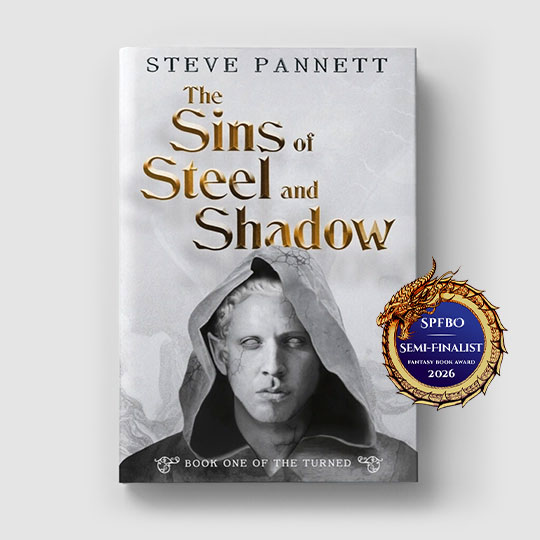
The Sins of Steel and Shadow
Hated and reviled by humans and vampyrs alike, every day for a Turned is a deadly struggle. But when Bail is offered the chance of a lifetime, there’s much more at stake than just his survival.
The Turned series is a fast-paced, character-led, gritty fantasy saga for fans of Joe Abercrombie or Scott Lynch.

Steve Pannett is an author and designer based in Yorkshire, UK.
He writes primarily in the fantasy genre, combining character-led storytelling with epic, gritty world-building to create dark tales with plenty of action and lots of twists along the way.
He has self-published multiple books and is active online.