As part of an ongoing series of posts, I sat down for a (virtual) meeting with another indie author in the fantasy (and horror) genre. Here’s how my chat with author Tobias Youngblood, went.
The interview
Introductions and on reading
Steve Pannett (SP): Tobias, nice to meet you. Do you want to introduce yourself and your work?
Tobias Youngblood (TY): So, I’m Tobias Young Bloodood. I’ve been writing since about 2018. I’ve been published since 2022 so I’m still relatively new to the publishing scene, and I’ve been indie from the get-go. I have just completed an urban fantasy trilogy. They’re sort of neo-noir urban fantasy. Multi-POV, but with a one-character driven narrative over the three books. There’s also a prequel novella which feels more medieval because it takes place hundreds of years before the events in the novels.
I’m not strictly a fantasy author, although fantasy is probably my number one genre, but I also really like horror and sci-fi. So, all three of those are definitely fair game for what I’m going to write.
SP: Okay great, talk to me a little bit about your foray into horror then. We’ll come back to the urban fantasy trilogy in a little while.
TY: So I actually co-author horror stories with my son (pen name Oliver Shade) and we’ve written one book in a series so far, but we’ve got maybe ten more mapped out ready to be written, too. They’re very short stories—you could read them in two or three hours—and are sort of like Goosebumps but for grown-ups.
SP: You’ve sold me on them already. I will talk to anyone I can about how Goosebumps got me into reading (and then into writing). It sounds like a great project.
TY: Thanks. Book 1 is called Death Sketch and the next one will be out very soon.
SP: Ace. So, I’ve just touched on some of my earliest reading memories, there (with Goosebumps). What about your own? Where did your reading journey begin?
TY: I would say maybe The Hardy Boys mystery books, when I was real young. I just loved the plots and trying to figure out who’d done it, which hasn’t translated into anything I do now—so far, at least. But I just enjoyed reading them so much.
After that I think I would say the next step was either The Chronicles of Narnia—which I absolutely loved as a young child—or the other one was I came across Roald Dahl, Charlie in the Chocolate Factory. Although my number one book by him, that I absolutely love, is Matilda. I read that book over and over. The thing I liked about it was it’s just so wacky, imaginative, quirky — but also there’s an underlying dark current to all that stuff, which I found very appealing for some reason.
SP: Yeah for sure, I think that typifies Roald Dahl’s work. Mixing whimsy and darkness so well.
TY: Yeah, and then after that I got into JRR Tolkien. And I absolutely love Stephen King — he writes across so many genres.

On writing
SP: And did all of that interest in reading translate straight into writing? I know you said you were published in 2022 but did you start actively writing well before that?
TY: I remember dabbling with writing when I was younger, but I think the reason I didn’t get into it more is because I played music and so that was my creative outlet. I think that kinda took all that creative energy out of me. I probably didn’t quite get it back then, anyway.
SP: So you don’t have your earliest manuscript still?
TY: I do not. I think it was probably written by hand anyway so who knows!
SP: Yeah my first draft of anything was saved on 125kb floppy disks! I had to store the whole thing over a series of different disks.
TY: Oh wow!
SP: I know! So, tell me about writing then. Do you have any set rituals for getting in the zone or do you just try to snatch 20 minutes wherever you can? How does it work for you?
TY: So I get distracted pretty easily, but at the same time I can focus in real hard when I get in there. I use a white noise app on my phone with headphones every time I write because I think when I can hear that it just kind of triggers me to be in the zone. I used to try to use music but then I was like “now I got to make playlists and if it doesn’t match the scene it’s just more work” – that’s not what I need.
SP: Yeah, I’m with you on that. I occasionally dabble with some pre-curated fantasy music playlists on Spotify or whatever. But if I’m writing a battle scene and the theme music for the Shire comes on…
TY: Right. Right. It’s not the right match. So then you’re just like, ” let me fix it!” — and it’s just another distraction!
SP: Yeah. Exactly. So, white noise and very much set focus time. Door closed, white noise on – you’re in the zone?
TY: Yeah. I try to write early in the mornings, before my day job. I really try to be disciplined and get up to do it. And I’ve slipped many times with this, but when I get into that rhythm, it works for me.
I also just started something new late last year, finishing book three in the trilogy. I started writing on my phone, too. I’ll just do text-to-speech in my Notes app for my story and that adds several hundred words a day by just doing that.
SP: Nice. I like hearing how other authors write. I don’t think that method would work for me — my Notes app is an absolute wasteland of half-baked nonsense! But that’s cool. What about writer’s block then? Is it something you encounter? And, if you do, do you have any tricks for breaking through it?
TY: I don’t wanna be enemy number one, but it’s not really been a major issue for me. And I guess I can say that, whenever I’m not sure about a certain thing, I will just write another scene or something that I already knew was going to be in it and then it would just kind of fill itself out for the most part. I’m not saying I’ll never encounter it, but it hasn’t been a major issue for me. But what I do struggle with really bad is what I call shiny nugget syndrome.
Essentially, you’re working on something, you want to finish it, you need to finish it — but there’s this other idea of a story that you just are in love with and you just want to write it. But then there’s a risk that you never finish anything!
SP: Ah yes, I know the shiny nugget problem well.
TY: Yeah, well in Stephen King’s On Writing he talks about this. And he actually says you should chase the shiny nugget in that book, because you want to strike when the iron’s hot.
SP: Yeah I love that book. And I get his reasoning, too. His argument is that you need to really want to write the thing you’re writing. So if you, as a writer, aren’t fully enjoying the thing you’re writing…how do you expect your readers to enjoy reading it, right?
TY: Yeah exactly, but it does not help me at all because I think if I follow that advice, it would be terrible! And yeah it’s not because the thing you’re working on is a struggle, it’s just because the other thing is fresh and the idea is new. But I think that’s kind of a trap – because everything’s more exciting when it’s just speculative!
SP: For sure. Okay I’m going to pivot a little bit now and talk about characters. Characters are so important to me when I’m reading a story. They make or break it for me. Do you agree with that, and do you have a favourite that you’ve written?
TY: Yeah characters are really important. If you don’t have great characters then nothing else is going to really fall into place.
I would say my favorite character is probably Siv, who’s one of the insectile shape-shifting creatures (from the urban fantasy Projectionists series) and he’s a seer, so he’s kind of like the wisest of their kind. He became my favourite character that I’ve written, I think, because he cares about his clan. He feels responsible for them as he’s someone they turn to for wisdom and he tries to do the right thing.
I love that he’s pretty multi-dimensional. I think in his interactions, especially. Discovering how to interact with humans and developing relationships with them and how he’s trying to understand the way humans think about the world, and how it’s different from his own species. And his own species is going extinct, too — so he’s also trying to take ownership of their legacy. How will they be remembered after they’re gone? That kind of thing. So yeah I think Siv.

On the future
SP: Nice. So let’s put a spotlight on the Projectionists series then. What is it that you want readers to take away from that series?
TY: I would hope that readers would say that they found it very unique. I’d like them to be caught off guard with just how different it is — that it didn’t meet genre conventions for urban fantasy and it was also different to dark fantasy — but it wasn’t quite epic fantasy. It had elements of horror and sci-fi, but could be enjoyed by anyone that enjoys those genres.
I would hope they would say that at a high level. But I also don’t write things with the intention of trying to get a specific message across. I have no interest in that. I think that there just naturally are lessons in anything you write.
SP: Okay cool, so you want readers to come away pleasantly surprised by how unexpected the books are. And yeah I’m with you on not necessarily writing with a set goal of being thought-provoking, as such – it just comes organically, almost. Alright, I think we’ll wrap things up there for now. Thank you for chatting to me, Tobias.
TY: Appreciate it! Talk to you later!
Tobias Youngblood is a multi-genre author with a range of published works—including The Projectionists series and the Nightmare series—available to buy and read.
📚✌🏻SP
Share this post
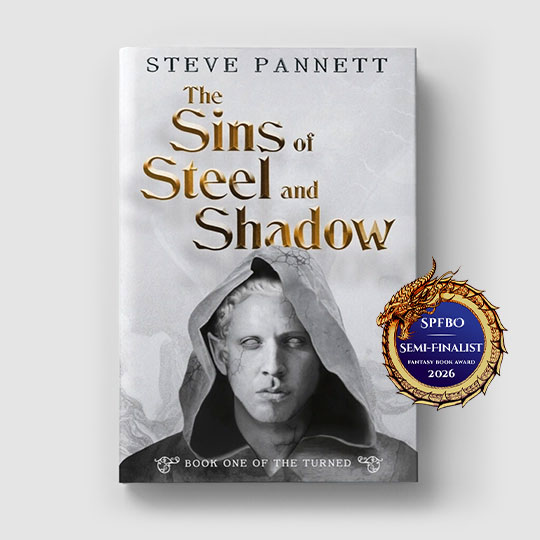
Book One of the TURNED
The Sins of Steel and Shadow
Hated and reviled by humans and vampyrs alike, every day for a Turned is a deadly struggle. But when Bail is offered the chance of a lifetime, there’s much more at stake than just his survival.
The Turned series is a fast-paced, character-led, gritty fantasy saga for fans of Joe Abercrombie or Scott Lynch.

Steve Pannett is an author and designer based in Yorkshire, UK.
He writes primarily in the fantasy genre, combining character-led storytelling with epic, gritty world-building to create dark tales with plenty of action and lots of twists along the way.
He has self-published multiple books and is active online.