In a previous post on this website I’ve already declared David Gemmell’s Rigante series to be the greatest gaelic-inspired fantasy series ever written. So you can assume this review will be positive. But let me break down in more detail, book-by-book, exactly why I think that is. This time I’m reviewing book 2 in the series, Midnight Falcon. And here’s my review of book 1 in the series (Sword in the Storm) in case you wanted to start from the start!
My reviews of the other Rigante books:
- Sword in the Storm review (Book 1 of the Rigante)
- Ravenheart (Book 3 of the Rigante)
- Stormrider (Book 4 of the Rigante)
The review
Midnight Falcon is a direct sequel to the first book in the Rigante series, Sword in the Storm. It follows a well-established* technique in fantasy books whereby the opening book follows one generation of characters, with subsequent entries then following the next generation. It’s a very effective form of storytelling because we, the readers, get the compounded effect of seeing characters we already know and finding some new ones, too. I actually think this is part of what makes Joe Abercrombie’s First Law saga so compelling, because it’s nine books (at the time of writing) that all build on the work that came before.
*I’m not scholarly enough to know if this technique was well-established when David Gemmell first published the Rigante series. If it wasn’t then we can safely assume he helped pioneer it!
Anyway, book 2 in the series follows Bane, the bastard son of Connavar — flawed hero of the first instalment. In case you were wondering, the title of the book comes from Bane’s Rigante “soulname”, which is Midnight Falcon. Again, this is another technique used throughout the series (Sword in the Storm is Connavar’s soulname). It doesn’t have much bearing on the stories, but it’s another tick for the continuity that gives some readers that warm, fuzzy feeling.
Bane is, like his father, a troubled individual. Moreso, in fact, because he has grown-up as something of an outcast. I won’t spoil the latter-stage events of Sword in the Storm, but it’s safe to say that both Connavar and Bane are suffering as a result of the former’s actions. Not only that, but the threat from the mighty Stone empire has grown, too. Stone (which is Gemmell’s fantasy-depiction of the Roman Empire, in case you were wondering) is still led by Jasaray (Julius Caesar), but the man insists he has no quarrel with the Rigante, despite them being the only enemy to inflict a defeat on the otherwise invincible armies he commands.
Bane finds himself accompanying his friend Banouin (junior) as the latter wants to journey to see the home city of his father, Banouin senior (again, no spoilers for what happens in Sword in the Storm). And so we have a troubled young Rigante heading to the very heart of the empire of Stone. Already a great set-up. But what David Gemmell does so effectively in all of his books is he understands when to raise the stakes. In Midnight Falcon, the inciting incident comes early and it hits hard. It leaves Bane badly wounded, alone and with one hell of a revenge quest on his mind.
The book then diverges from Sword in the Storm, because we then follow Bane as he makes his way to Stone itself (during a time of much political turmoil). Not only that, but he joins the ranks of the exalted gladiators, believing it will earn him his chance at revenge. This plotline is very well executed, as Gemmell proves he can weave multiple character arcs—including some lesser characters—without slowing the pace. The fight scenes are excellent and the politicking, the zealous religious persecution and our protagonist’s story all culminate in a very exciting climax.
What’s truly remarkable, though, is that this climax is reached at around two thirds of the way through the book. If you’re anything like me, you’ll be blown away by the storytelling on show up to that point—and therefore astonished that there is still a large chunk still left to go.
And a large chunk there is! Bane travels back to the lands of the Rigante, only to find the clan in even deeper trouble than ever. Beset on multiple fronts, he is left with a decision to make. In true David Gemmell style, the second major climax of the book is a masterful mix of betrayal and poignance, all handled with wit and a deep understanding of his characters. Suffice to say, it’s a hell of a ride.
Style and approach
And the writing itself is Gemmell at his very best. I don’t think anyone will ever claim his prose is particularly lyrical or poetic, but it is so sharp and crisp that you will find yourself swept along by the story, rather than reading it. The dialogue can be a touch wooden at times, but that feels more an observation of fantasy novels of this period as opposed to any real criticism.
Where Gemmell really excells with Midnight Falcon, though, is in his character work. As I mentioned at the start of this review, we have a host of characters that we return to (primarily Connavar, his family and friends — but also Jasaray, who is brilliantly written). We also have a whole cadre of new and interesting characters: Bane himself is frighteningly compelling, and Banouin is a touch irritating but nevertheless well-realised. And then you have the likes of Rage, Persis Albitane (and his canny assistant, Norwin), Voltan and Nalademus. A heady mix of gladiators, circus owners and religious leaders, all of whom are flawed and—as Gemmell is so good at showing—human.
This cast of characters are augmented even further by the setting. Gemmell’s depiction of the Rigante homeland is the stuff of a fantasy purist’s dreams. And his realisation of the city of Stone is juxtaposed against it brilliantly. My one, miniscule criticism is that this latter setting doesn’t get quite as much “fleshing out” as it probably could have done — but I also understand that doing that may well harm the pacing, and I bow down to Gemmell and his team in their judgement.
The themes of the book largely follow the same vein that was tapped by Sword in the Storm. The nature of evil. The capacity of good and evil within each of us. Do two wrongs make a right? Should you just bury the past? And they’re all explored in expert fashion, through the lens of some wonderful characters.
Conclusion
As a teenager, Midnight Falcon was my favourite of the Rigante books. I think I was particularly drawn to it because there are some striking parallels with Ridley Scott’s movie, Gladiator (one of the most perfect films ever made, and I’ll brook no argument there). As I’ve gotten older, I’ve actually developed a new favourite from the series, but this book still holds a very special place in my heart. I would even go so far as saying that it’s better than Sword in the Storm, but only because it gets to stand on the shoulders of its predecesor. And stand it does! Tall and proud. Just like a true Rigante should.
📚✌🏻SP
Read my review of the next book in this series, Ravenheart (Book 3 of the Rigante)
Share this post
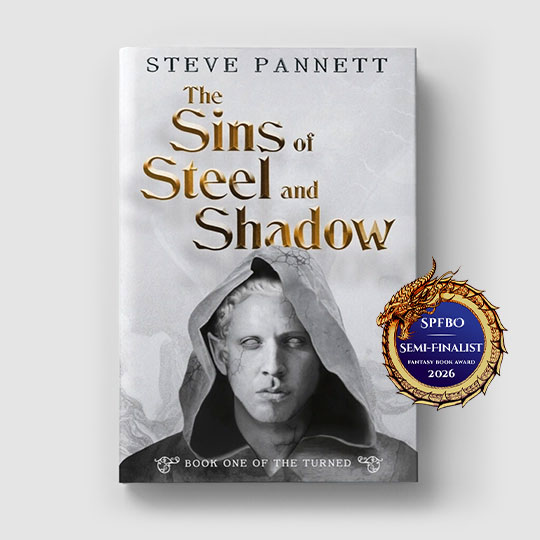
Book One of the TURNED
The Sins of Steel and Shadow
Hated and reviled by humans and vampyrs alike, every day for a Turned is a deadly struggle. But when Bail is offered the chance of a lifetime, there’s much more at stake than just his survival.
The Turned series is a fast-paced, character-led, gritty fantasy saga for fans of Joe Abercrombie or Scott Lynch.

Steve Pannett is an author and designer based in Yorkshire, UK.
He writes primarily in the fantasy genre, combining character-led storytelling with epic, gritty world-building to create dark tales with plenty of action and lots of twists along the way.
He has self-published multiple books and is active online.