Great characters are what make great stories. Readers are immersed in books through their settings and they love following a plot-line to its (hopefully brilliant) conclusion, but what connects them to a story is the characters in it. So here’s my advice for how to write them.
But before we begin, a few caveats.
Firstly, I’m not arrogant enough to consider myself the supreme authority on writing characters – although I do consider it one of my strengths as a writer (and it has been commended by complete strangers who have read my books, so I do take some pride in it). This post is just my opinion, and some of my methods, on character work in a novel.
Secondly, the advice in this post may or may not be transferable to you or your writing. I write gritty fantasy fiction novels, which means that there is rarely (but not never) space for long-running romantic arcs. Subsequently, this means that the focus of my characters is probably different to the focus of characters in books of that genre. It doesn’t make the suggestions in this post completely foreign concepts, but it’s worth bearing in mind.
Thirdly, this is me telling you how I write characters, not me telling you how characters should be written. There is no right or wrong way of doing it, just as there is no right or wrong way of writing. But, if something in this post helps you out then it has served its purpose!
Ok, caveats have been caveated, let’s do this! Here’s my advice for writing brilliant characters.

Don’t do it all at once
Just like any relationship, you need to spend time with your character in order to understand them better.
Don’t try to create an entire person (or alien/elf/talking dog/anthropomorphic fridge etc etc) in one fell swoop. Character sheets are useful tools, but I wouldn’t try to build one from scratch and then stick to it like it was gospel – instead, you should add to it as your story develops and you discover (rather than prescribe) how your character behaves in certain situations.
You might be the writer, but you’re a reader, too. That means you need to scrutinise your characters’ decisions and behaviours, rather than force them to fit a preconceived mould of your devising. Even as their creator, you’ll be surprised by how often your own creations will “do” something that feels unexpected. Don’t be put off by that, you should only ever write your characters doing and saying things that feel natural to them. Building a rigid character from the very start—and then refusing to deviate when they develop more naturally—will stop you from doing that.

Do keep notes
That doesn’t mean you shouldn’t have character sheets at all. In fact, they are incredibly useful tools (so long as they’re more of a “living document” than a one-and-done stone tablet that can never be revisited).
Not only that, but if you’re writing a novel then the chances are you will have more than one character to keep tabs on. Even in a single-POV novel, your main character (MC) is unlikely to be completely alone – and that means you need a way of documenting each member of the cast.
The level of detail you go into here is entirely up to you, but here’s how I do it:
- Open up a spreadsheet (yep, really)
- Create a tab called Glossary
- Start by creating some filterable columns
- Filterable by character/place/sect (this glossary will cover your entire world, not just the beings who inhabit it)
- Filterable by the book they first appeared in (if you’re writing a series, or books set in the same universe)
- Filterable by any other parameter you see fit (allegiance of the character, birthplace etc etc)
- For characters, populate the following:
- Full name
- Any other names they go by
- Age
- Physical description
- Core principles
- Primary motivation
- Notes
I personally use a few other ones that feel more specific to my writing. For example, I have a “when did they die?” column because well, being one of my characters is a dangerous business. You, however, can split the columns out how you see fit (these are just the most important ones that I capture) but ultimately you want a one-stop shop for tracking any characters that you introduce into the story.
And I do mean any of them. Trust me, if you name-drop an ancillary character in one line of throwaway dialogue, make sure you then capture those details in your glossary. It’s much easier to find someone’s eye colour by revisiting a spreadsheet than it is to search an entire draft. Make your life easier, keep notes.

Dialogue is key
So much of what we learn about people is through speech and dialogue. Not just what they say, but how they say it, and then—subsequently—whether or not their actions match what they said or how they said it. You follow?
So, to write great characters, you need to be able to write great dialogue. Now, that skill warrants another post all on its own, but let me give the abridged version here: great dialogue should never feel forced.
One of the best ways to check for this is to read your dialogue aloud. Even better if you can convince someone to read with you. Doing this should show you any immediately obvious flaws in how your characters talk to/with one another. After that, you need to get comfortable scrutinising the cadence of speech patterns and using an appropriate vocabulary (remember, not all characters will have the same breadth/depth of verbage). Perhaps most importantly, try to keep exposition out of your dialogue.
The first two are all part of the craft, but that last one can be a killer. Nothing makes a character feel more hollow than having them outright explain the plot to the reader. If that’s happening, then your story needs some major editing—and it leads me neatly onto my next point…

Show don’t tell
Ah yes, the classic piece of writing advice. Like all things, this guidance needs to be taken in moderation (rather than as a dogmatic rule to live and die by) but in developing your characters it is important to show your reader what they’re like, rather than simply telling them.
For example: telling your audience that a character is nasty feels wooden, but showing them your character kicking a dog for no reason will convey it instantly. It will also inspire a deep-rooted hatred of them for all eternity, so don’t expect a comfortable redemption arc for ole Dog-kicker, there.
So, stop explaining every detail of your character and let some of those details bleed onto the page in a more natural way. Don’t make it too mysterious—otherwise your reader will have nothing to relate to—but don’t info-dump, either.
This is your novel, not your spreadsheet.

Mannerisms are great tells
Just like dialogue, mannerisms are a great way of communicating your character to your readers and making them (your character, not your readers) feel much more real.
Better yet, the right mannerisms—deployed strategically and with a degree of care—can become signifiers and identifiers of the character, too.
A particular refrain might become synonymous with your character. Or maybe they have a go-to expression that a reader can associate with their personality. You might even be able to pick out particular individuals in sections of back-and-forth dialogue between multiple characters—without the need for dialogue tags—just based on particular words or inflections. This will deepen the connection to your characters, because your readers will start to recognise them without the need for overt callouts.
Try not to overthink mannerisms. These details are things we observe in real people every day, often without realising it. Certain words, expressions or behaviours feel very specific to individuals you know yourself. So you just need to translate that kind of thing into the characters you write.

Explore nuance and three-dimensions
Great characters are great because they’re not one-dimensional or flat.
The best villains aren’t evil incarnate; they’re more complex than that. Their motivations are understandable and, even better, relatable. That’s because they’ve been written as rounded, fleshed-out, fully-formed characters—as opposed to caricatures of singular concepts.
One of my favourite authors, Joe Abercombie, is widely considered one of the best at doing this. In every book he’s written, he’s managed to create a deeply flawed set of characters—including any MCs—but he will have you rooting for some of them, because we have more of an understanding of them. There are very few you could call typical heroes, and fewer still you could call outright “good people” – but there aren’t many villains (except for some of the really sadistic ones) who you can label “evil”, either. That complexity is exactly what makes the character work so brilliant.
Great characters are rich and layered. They’re skilful and they’re flawed. They are clever in some areas and useless in others. They are nuanced and complex. Writing all of this isn’t easy, but you’ll need to explore the many facets of your characters to make them more compelling to read.

Strengths and weaknesses
When you’re writing, remember that strengths and weaknesses aren’t as fixed as you might think. For a start, they’re dependent on perspective. Being a great warrior might make you physically strong, but that strength will be wasted on something equally physically demanding, like farming. Likewise, the world’s greatest butler is probably not going to be much use in a fight.
(Of course, you could subvert both of these assumptions, and that might be what makes your characters compelling – no one said this writing lark has to all be the same!)
My best piece of advice is to look at things through that lens of perspective, and keep in mind that strengths and weaknesses come in many forms. Strength and courage doesn’t necessarily translate to being comfortable with confrontation or physical violence. This tends to be where some (but by no means all) male authors (like myself) struggle in writing strong female characters in the fantasy genre—because we often default towards thinking of strength through more typically (and westernised) masculine pursuits. But female characters don’t need to be great warriors in order to be strong (though, obviously they still can be).
I’ve already written about one of the best examples of this when I covered David Gemmell’s Rigante series. In Ravenheart (Book 3 in that series) we are introduced to the character of Maev Ring. She is the aunt of our MC, Kaelin Ring, having had to raise him after Kaelin’s father is killed by the villainous (but complex) Moidart during the book’s prologue. Maev is a fierce clanswoman, with a sharp mind and an eye for business (despite being both a woman in a man’s world, and a Rigante in a Varlish-controlled community). She absolutely commands every scene that she appears in, but only in very rare instances does that mean she has to resort to violence of any kind. She is, in short, one of the best female characters that a male fantasy author has ever written—and a lot of that comes down to David Gemmell’s understanding of strengths and weaknesses, and the lens of perspective.

The journey is the point
Just like in real-life, your characters need to develop and change as their story unfolds. This is, after all, their story.
The pace of this change needs to be managed, of course, and that’s where you come in. Some things will have a monumental impact on your characters. The death of a loved one, for example, or some kind of traumatic experience, are likely to leave a mark, even if it’s only a temporary one. Other changes will happen more gradually. Perhaps your character starts to mature and come to a realisation about themselves or others, over the course of months, or even years. As the writer, it’s your job to ensure that this change happens at a speed that feels natural to the story.
You also need to be mindful of what can change, what should change, and the difference between the two.
This is where that pesky nuance and complexity comes into play again. For instance, your character might have a core principle that shapes how they act and what they say—but is there anything that could shake that unwavering belief? Anything that could challenge their principles? After all, as the old adage goes, “a principle only has value when it comes at a personal cost” – so what cost would be too high for your character? What would force them to change? What effect would that have on the story itself?
When I’m drafting, I like to follow the internal/external framework for writing each chapter. Simply put; the external part refers to the plot or the story. The chapter needs to somehow advance that in a meaningful way, or my readers will get bored. At the same time, though, the internal part refers to the development of the characters. How is the story changing them? How is their arc developing? Because if the chapter doesn’t also service that part—even in a small way—then my readers will become disinterested in hanging out with rigid, wooden characters who always stay the same.

Try something different
This advice goes for all writing, but in character work it basically means try to avoid overdone clichés.
There’s a really good example of this in Scott Lynch’s Gentlemen Bastards series, where the character Jean is both an accomplished brawler, physically imposing and comfortable with violence, and he’s a uniquely clever, intellectual and savvy individual. This is such a simple thing, but having a character who doesn’t sacrifice brains for brawn (or vice versa) is a great way of moving away from some widely accepted “norms” – again, it’s all about capturing nuance.
That being said, you want to avoid writing a Mary Sue character (a character who has zero flaws or weaknesses) because they end up being one-dimensional and difficult to connect with. Likewise—and contrary to the advice I just gave in the sentence before—your story might actually benefit from a cliché or two. Maybe it keeps your book grounded in a familiar space. Maybe you’re writing with particular tropes in mind. Hell, maybe you just want them to be a bit clichéd. Those are all valid answers; it’s your story!
Whatever you do though, don’t be afraid to try something different when it comes to shaping your cast of characters. That’s how we move the art-form forwards, as a collective.
Conclusions
Great characters are central to a great story, so refining how you write characters is always a worthwhile endeavour. I suppose my biggest piece of advice is to ask yourself one question: does this feel natural?
It sounds a bit loose, as advice goes, but what I mean by it is you shouldn’t consider yourself the creator of these characters. You are the writer, sure, but you are essentially documenting what you see. You’re an observer, first and foremost. So if your documented observations feel hokey, forced or unnatural in any way, shape or form—be it what they say, how they say it, or how they behave in any given situation—then you probably need to revisit your character work.
Best of luck, and for the love of the craft make sure you enjoy it!
If you’d like to see if I practice what I preach, please check out my published books and see for yourself!
📚✌🏻SP
Share this post
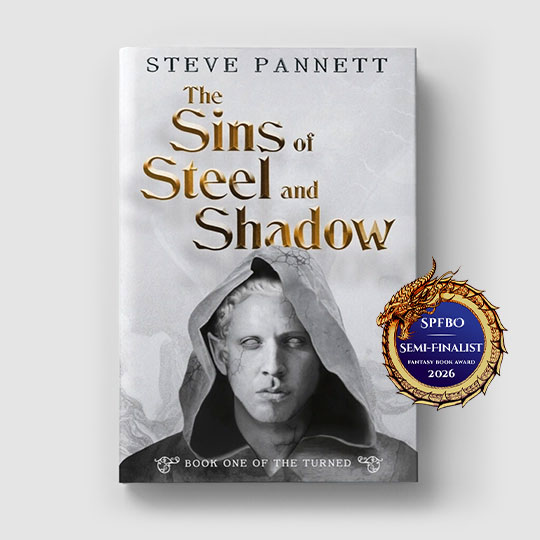
Book One of the TURNED
The Sins of Steel and Shadow
Hated and reviled by humans and vampyrs alike, every day for a Turned is a deadly struggle. But when Bail is offered the chance of a lifetime, there’s much more at stake than just his survival.
The Turned series is a fast-paced, character-led, gritty fantasy saga for fans of Joe Abercrombie or Scott Lynch.

Steve Pannett is an author and designer based in Yorkshire, UK.
He writes primarily in the fantasy genre, combining character-led storytelling with epic, gritty world-building to create dark tales with plenty of action and lots of twists along the way.
He has self-published multiple books and is active online.