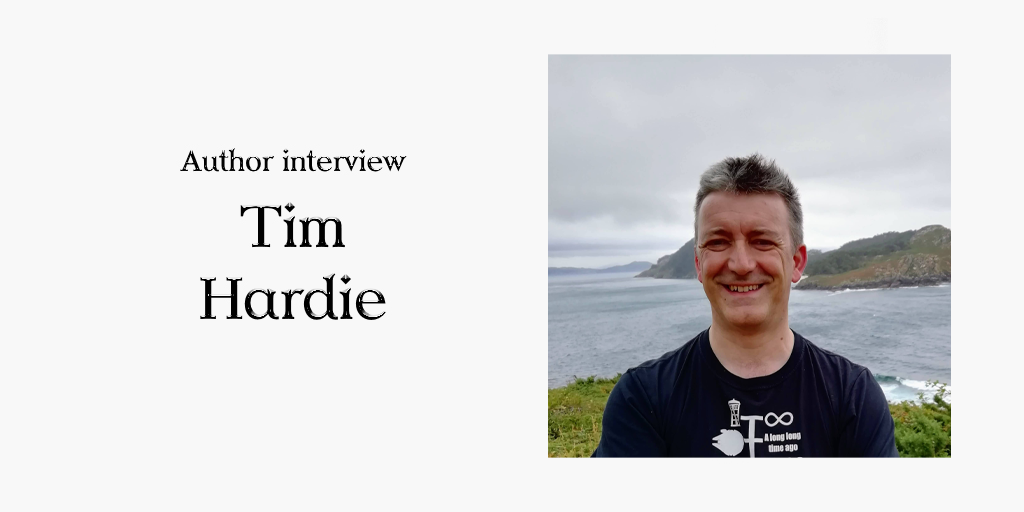
As part of an ongoing series of posts, I sat down for a (virtual) meeting with another indie author in the fantasy genre. Here’s how my chat with Tim Hardie went.
The interview
Introductions
Steve Pannett (SP): Tim, we’ve met before (in-person for the first-time at a Spotlight Indie live event) but do you want to introduce yourself a little bit?
Tim Hardie (TH): I’m an indie fantasy author and have been for quite a few years now, which seems like only yesterday this was all brand new, but all of a sudden it’s six years down the track since I’ve been active. I write epic fantasy. I tend to term it dark epic fantasy, and I’m probably best known for writing Viking-inspired fantasy.
That particular series is my own fantasy world, but with a bit of Viking flavour to it. I have also expanded that world with other projects I’m working on. So, that’s probably my main project at the moment.
SP: That’s the Brotherhood of the Eagle series?
TH: Yes, that’s the main series that I’ve completed. So, book one of that, Hall of Bones, was a SPFBO finalist back in 2021. And since then, I’ve basically finished writing the rest of the series. So, I finished the four book cycle in 2024, so it’s all there ready to be read. I put out a standalone in the middle of that cycle as well. It’s a Middle Eastern/North African inspired setting which is in the same fantasy world…but on a different continent. So that’s a book called A Quiet Vengeance which is a standalone but I want to continue the story.
SP: Lots of projects on the go, then?
TH: Absolutely, I’m also kind of busy over on Patreon as well!
Then I’ve got a prequel novella (for Brotherhood of the Eagle) but with none of the main characters, and then I’ve also got another story which is pushed a little bit back in time. Same Viking-inspired region, but different clans on the other side of the world. They’re kind of like an underused resource. So I’m working on lots of Brotherhood of the Eagle adjacent stuff.
And then alongside that with Patreon, I’ve also started to do a weekly chapter release of my new novel in my new fantasy series. So, I’ve also been experimenting with a gas-lamp fantasy novel, which is called The Silent Division.

On writing
SP: So with all those irons in the fire, it’s probably a good time to ask you about your approach to writing. Do you feel the pressure from all of those concurrent projects, and does it help or hinder?
TH: So, I’ve decided that nothing helps productivity and creativity more than an insane amount of weekly pressure.
With the Patreon, I’ve got about 20 chapters written already and I’m releasing them once a week. That’s 20 weeks which then actually gives me quite a few months to get more things done. I’m already ahead with writing the other half of the book. But absolutely, the pressure helps.
For that project I’ve had a really interesting writing experience because I’ve had to involve a couple of sensitivity readers in that process—because part of the book involves deaf culture and handling that side of things obviously needs a degree of sensitivity. I’ve worked with a couple of people, one who helped to create a framework for me to consider from the outset, and another who is reading chapter by chapter.
SP: That’s commitment!
TH: Yeah! I’ve never met this guy, but he’s great. It’s also kept me honest and, I think, has helped keep me on track. So with the way that the first 20 chapters came out, I’m fairly confident that I can replicate that journey with the rest of the project. And I feel a lot better, knowing that’ll keep it moving. So, I’ve got a number of…incentives, almost, working away there.
SP: It’s so fascinating to me how much external accountability can drive a writer forwards. When I’m writing, my main source of that comes from my wife, who just really wants to read the story. It sounds like you’ve had similar positive experiences from having that external accountability.
TH: Yeah there’s obviously a very exposing thing of sharing your first draft with people, and I think this (sharing first draft work with early readers/experts) would not work for everybody. But I think there’s accountability in that I don’t want to leave him (the sensitivity reader) hanging.
I actually am currently leaving him hanging, which is a bit bad—but I have told him this and I’ve given him an estimate of when I think I’ll have the second half ready for him. But yeah, it definitely helps to motivate me, and his input has been invaluable. He’s come up with new angles on things, he understands “show don’t tell”, he understands what gives a character veracity and how you can believe that character’s journey. He really is good.
SP: He’s a reader! They’re a discerning bunch!
TH: 100%

On reading
SP: Speaking of reading, do you want to give me a bit of an insight into your own reading journey? Where did it all start for you?
TH: Yeah happy to do that. So I’m a child of the 70s. So when I was growing up I was able to lean into a lot of the classic fantasy from sort the 40s and 50s and 60s. So early on, Tolkien was a huge influence. People like Alan Garner, Susan Cooper or those sort of classic fantasy tales. CS Lewis to a degree as well, but I never quite vibed with his books as much.
And then I suppose I was also fortunate enough to be around in that explosion of fantasy in the 1980s as well. So Stephen Donaldson coming along, and I’ve always had a soft spot for Dragonlance. So I like the lighter stuff and also some other more heavyweight stuff.
HP Lovecraft’s been another one. I know he’s got his issues as a person, but as a writer, you can’t fault the imagination in what he was able to start to bring into the mainstream. The impact it had on popular culture.
And then I’m a bit of a strange one…because I kind of fell out of love with fantasy in the 1980s. So, as I left school and went to university, I think I found fantasy was repeating itself a bit for me. And I struggled to find something that really gripped me. So I actually turned to sci-fi!
Iain M Banks became a really important writer to me—I discovered him when I was in my early twenties. I also went into a phase of enjoying thrillers. So Ian Rankin’s Rebus series…a bit of John Grisham—those kind of books were quite prominent on my shelf at the time.
SP: Quite a broad palate, though.
TH: Yes, but probably the single most important book in my writing journey—and I’ve probably forgotten some of the key ones along the way there—but it’s Bridget Jones’s Diary by Helen Fielding.
Because it is so funny and so wickedly accurate, but it’s also actually the thing that got me started with the writing bug.
So I’m old enough that I was around when it started as a newspaper article that came out on a daily basis. People were still debating whether or not Bridget Jones was real…so, I was there right from the start. Helen Fielding is an amazing writer. With Bridget, she had the perfect voice to articulate the problems of being a 30-something woman in the 1990s.
It’s very funny, quite disposable, very pick-it-up-the-next-day-and-see-what’s-happened. And when I finished my degree, I was trying to pursue a career as a lawyer at the time—which got as far as getting through law college, but I could not get a job at the other end of it because we were in a recession. Bridget Jones is massive and I thought “why not document—in a slightly humorous style—my job hunting exploits” — and that’s where the writing habit came from.
SP: That’s your origin story!
TH: Absolutely. So, in a way, Helen Fielding is the reason you and I are talking today.
SP: That’s an incredible starting point. How did it all develop from there?
TH: So I suppose it was basically my diary as a form of fan-fiction, and that got me to the 2000s and then I started to think about how I’ve always fancied writing creatively. I think there was just a pull. I can’t really explain it. I never sort of sat and thought “today I shall be a novelist” or anything. But I did think “I can write all right. Why not try long form?”
So I started writing my first fantasy novel. It took me about five years to write that and I put it out to my agent and he rejected it. He told me that “This reads like fantasy from the 1980s. The genre’s moved on. If you’re serious about being a writer, I would recommend the following authors to you.”
I’ve lost the exact email that he sent, but I’m pretty sure I know for a fact on that list were Mark Lawrence, Joe Abercrombie, and I think Scott Lynch…who I still actually haven’t read!
SP: I love The Gentlemen Bastards sequence.
TH: It’s on my list! But I did pick up Mark’s Prince of Thorns, and I did pick up Joe’s The Blade Itself. And the latter is probably one of the main reasons why I’m now a writer. That book is phenomenal. Joe Abercrombie’s voice is phenomenal. His storytelling is brilliant. Some people say that it’s not got a plot. It has got a plot. It’s got a massive, brilliant, very clever plot.
SP: The whole First Law saga is just incredible. I love them all.
TH: Yeah, and then John Gwynne’s books, as well! And Robin Hobb. All of these authors have influenced my writing in some way.
Tons of influences from lots of different places and I think actually that’s not a bad thing. I think you might like a genre, and you might want to write in that genre but you can still learn things from other genres and other things way outside of that.
SP: I think that’s great, and I think that’s a wonderful place to leave it on, and to hopefully introduce you and your books to some new readers. Tim, thank you so much for your time!
TH: It’s been great. Thank you!
My thanks to Tim for sitting down to talk to me. If you’re an author who wants to talk reading, writing, and all things books, please fill out this form.
Tim Hardie is the author of The Brotherhood of the Eagle series, A Quiet Vengeance, as well as a contributor to anthologies and a prolific writer for his Patreon subscribers.
📚✌🏻SP
Share this post
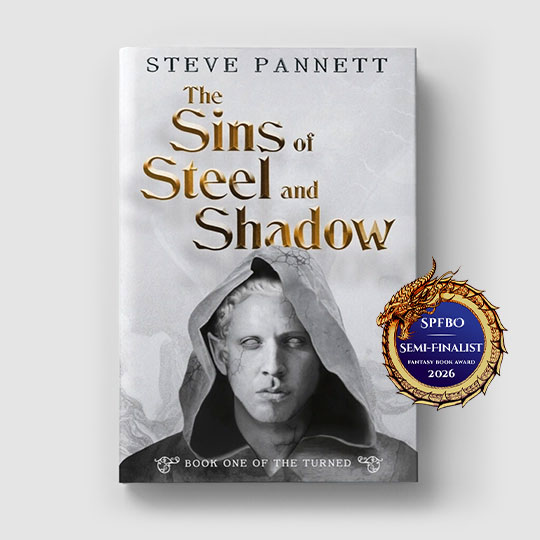
Book One of the TURNED
The Sins of Steel and Shadow
Hated and reviled by humans and vampyrs alike, every day for a Turned is a deadly struggle. But when Bail is offered the chance of a lifetime, there’s much more at stake than just his survival.
The Turned series is a fast-paced, character-led, gritty fantasy saga for fans of Joe Abercrombie or Scott Lynch.

Steve Pannett is an author and designer based in Yorkshire, UK.
He writes primarily in the fantasy genre, combining character-led storytelling with epic, gritty world-building to create dark tales with plenty of action and lots of twists along the way.
He has self-published multiple books and is active online.