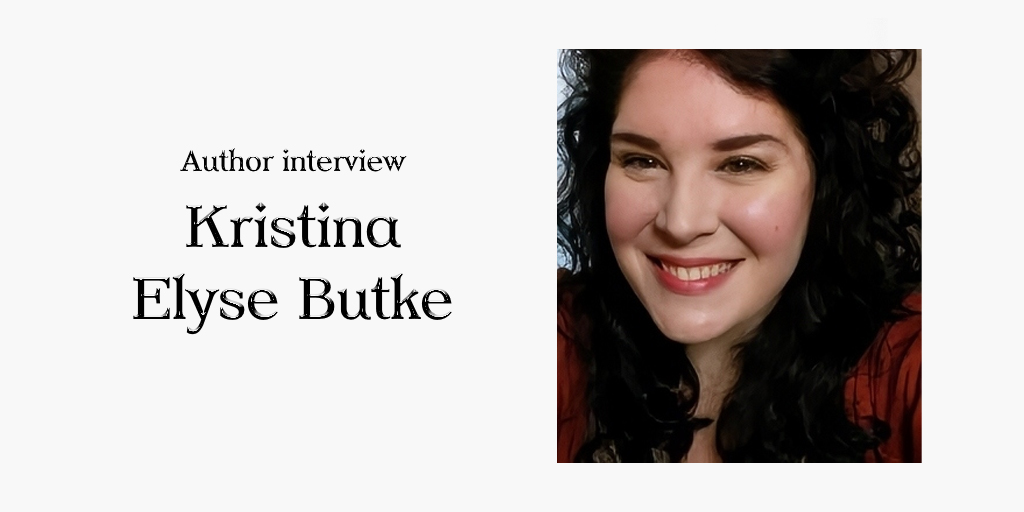
As part of an ongoing series of posts, I sat down for a (virtual) meeting with another indie author in the fantasy genre. Here’s how my chat with Kristina Elyse Butke went.
The interview
Introductions and on reading
Steve Pannett (SP): Kristina! Lovely to meet you. Do you want to start by telling me a bit about yourself and what you write?
Kristina Elyse Butke (KEB): Of course. I write dark fantasy with a touch of romance. I am currently working on a trilogy (The Darkening Gate trilogy). The Name and the Key just came out in July (2026). The second book, The Step and the Walk, comes out in October (2026) — and I’m currently writing the third book, The Fear and the Flame, right now. So, I’m a bit under pressure trying to wrap it all up and make it excellent.
I debuted in 2024 with a young adult fantasy called Son of the Siren. that was inspired by three fairy tales. Allerleirauh, The Six Swans, and The Little Mermaid — I took them all and I mushed them all together and gender swapped characters and I just had my fun with it! That was published through Oliver-Heber books and they are the ones who also signed me on for the trilogy. So I love fantasy very much — but I love everything with a little hint of darkness to it. So I’m not afraid to get into some bleak stuff or freaky stuff!
SP: That’s music to my ears, as dark, gritty fantasy is very much my own wheelhouse! So how is writing the final instalment in the trilogy going?
KEB: My gosh! I’m so far behind! I only knocked out the first chapter. I’m a bit stuck on a research point right now. There’s going to be a little bit of action in this one and I’m researching how to throw knives and how to do self-defence moves—
SP: The kinda stuff that makes your search history look really dicey, right?
KEB: Absolutely! It’s funny, the worst search was “How does a body decompose in water?” — and I was like, this looks pretty suspicious. Hopefully no one looks into that!
SP: Yeah I always find myself Googling something wholesome directly afterwards, just to try and balance the insanity a little bit! Ok, so talk to me about reading now. Can you share your earliest reading memory?
KEB: I started getting really into reading at seven years old — and it started with school readings where we would have these assigned units and these little books that had paper art in it and it was called Mortimer the Frog. And I just really loved reading that. I don’t remember anything about it I just know that I loved it very much.
And then I got into horror really early. There’s a really famous series called Scary Stories to Tell in the Dark by Alan Schwarz, and yeah, that was foundational to me. I read all of the books and the illustrations scared the crap out of me! But it was just wonderful. I loved the feeling that came from it.
SP: I was just about to say I think the pipeline from early-age horror into fantasy is pretty much a direct shot! So many authors I’ve spoken to in this genre have a similar genesis…myself included!
KEB: Absolutely!

On writing
SP: Ok cool. So do you want to tell me a bit about this trilogy then?
KEB: Sure. So it starts out as a coming-of-age story. It begins when the lead character, Lily is 13 years old, and she finds her mother’s body in the marshes. And ever since that happens, every time she looks in a mirror or glass or still water, she sees her mother’s reflection—bloated and distorted and rotting—and every time the reflection says, “Open the door. Let me out. You’re the only one who can.” And this follows her for years.
It’s not until Lily’s 18 years old that her friend from overseas comes back to see her. He’s studied alchemy and dark magic and has made deals with demons and all that stuff…so he thinks he can help. So the story starts down this road of very treacherous magic and it explores the things that you’re willing to do to end death, and all of the sacrifices that you’re willing to make.
The story is centred around family. Lily has a sister and a father — and of course there’s love between her and her childhood friend. That’s not a spoiler by the way! You can see that from the beginning. So it’s got a little bit of everything! But I love ghosts and demons and all that kind of stuff.
SP: Amazing, sounds great! So let’s rewind a bit now — can you tell me where your writing journey started?
KEB: So when I was really young, maybe 12 years old, I actually did playwriting. I rewrote plays like The Phantom of the Opera and Dr Jekyll and Mr Hyde, and then when I got older I continued doing that kind of thing. I wrote some original plays, and a musical, too. That was very dark, it was set in an insane asylum—
SP: How dark are we talking here? Like Marat/Sade dark?
KEB: Yes! That’s the nail on the head! I had actually seen that and just I thought it was brilliant and I was like, I want to do something like that where the prisoners are kind of interacting and we have these moments of real drama.
The musical was called Melancholia and I haven’t written a musical since then because it’s really difficult, and I don’t have the connections anymore to have people put it on. But with fiction, you’re writing things so much bigger anyway — on the stage there’s not enough room to really get into epic things. So, that’s kind of where I transitioned. But yeah I’m kind of a late bloomer with fiction!
SP: But all really useful experience! I imagine playwriting is one of those things that really hones particular aspects of writing. Dialogue, for example?
KEB: It’s definitely helped with dialogue! And continuity, weirdly, too. Writing from one scene to the next.
SP: And is that your process when you’re drafting? Or do you sometimes write a bit ahead and then revisit—
KEB: I’ve done that (revisting) very rarely. I’ve given it a try — but there’s this innate stubbornness that I have where things have to go in a chronological order or else my brain can’t handle it. I cannot bounce around when I’m writing!
SP: Yeah I think I’m the same. Even if I know (in a first draft) a scene is a bit basic or very rough, I still need to write it before I can move on to the next one! What about your writing process then? Is there anything specific about how you approach your writing? Or any preferred conditions that you like?
KEB: I can’t have distractions. I actually have a little sign on my door that says I’m writing. I swear. — and I used to have a ritual…where I put on an old sea captain’s hat.
SP: (laughing) Ok…I think these interviews have just peaked! You do what now?
KEB: I had this old sea captain’s hat! I would joke that I was “putting on my thinking cap” and then I would just put it on and I would be in the mode. But I have lost that hat. I have no idea what I’ve done with it, so I’ve learned to work without!
SP: Oh no! But I suppose this is a perfect time to say that if anyone is reading this who knows you personally…the perfect gift would be a replacement sea captain’s hat, right!?
KEB: Yes!

On publishing
SP: So you mentioned earlier you’re signed to (independent publisher) Oliver-Heber — do you want to talk a little bit about your publishing journey?
KEB: So I knew that I always wanted to be published — because when you playwright, you kind of want an audience…and that never went away.
I wanted to self-publish first, and I got quite far into the process with Son of the Siren. I had gotten the cover designed. I had the interior formatting. I had tons of beta readers, but I simply ran out of the money to continue the rest of the process! But I thought that the book was too good to shelve, so, at that point, I thought that I might as well just query it to see if it can get anywhere. I got, I believe, 35 rejections before I found my agent — who managed to sell it into Oliver-Heber!
SP: I love hearing success stories with independent publishers. I’ve written about the various routes to publishing and I do think it’s one of the ones that gets overlooked the most. Can you give a bit of insight into what to look out for? What should other authors be searching for? What are the green flags of an indie publisher?
KEB: So I looked at their roster and was impressed by some of the names on there. I also looked at the covers of the books they were publishing, which was a good indication to me that they put real effort into supporting their authors. But the biggest thing was that they were willing to let me have lots of input.
SP: I’ve talked before about how important these kind of arrangements are. Specifically how they should feel more like a partnership at times.
KEB: Exactly. And with Oliver-Heber there’s a real sense that they want to do more than just publish you — they want to nurture you as well, and help build your career.
SP: Lovely. And that’s a lovely note to end on, too. Kristina, thank you so much for your time and it was lovely to chat with you!
KEB: Thanks! This was wonderful!
My thanks to Kristina for sitting down to talk to me. If you’re an author who wants to talk reading, writing, and all things books, please fill out this form.
Kristina Elyse Butke is the author of The Darkening Gate trilogy, a dark adult fantasy series, and Son of the Siren, a YA fantasy story. You can follow the author on her social channels or keep an eye out on her website for all of her latest news!
📚✌🏻SP
Share this post
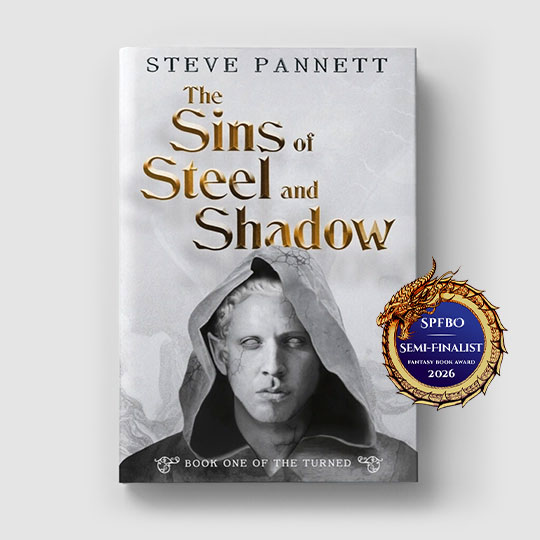
Book One of the TURNED
The Sins of Steel and Shadow
Hated and reviled by humans and vampyrs alike, every day for a Turned is a deadly struggle. But when Bail is offered the chance of a lifetime, there’s much more at stake than just his survival.
The Turned series is a fast-paced, character-led, gritty fantasy saga for fans of Joe Abercrombie or Scott Lynch.

Steve Pannett is an author and designer based in Yorkshire, UK.
He writes primarily in the fantasy genre, combining character-led storytelling with epic, gritty world-building to create dark tales with plenty of action and lots of twists along the way.
He has self-published multiple books and is active online.