
Writing a novel is a huge undertaking, and some of the decisions you make will be changeable right up to the moment you’re ready to submit the finished manuscript (either to your publisher, or—if, like me, you’re a self-published author—to your platform of choice). Other decisions though, are more foundational to your writing, and are much harder to alter once they’ve been made. Choosing which perspective to write in is one of these. First-person, second-person, third-person? So how do you know which is right for you?
The different point-of-views (POVs) available to you

First-person POV
First-person point-of-view is a writing style where your novel’s narrator is within the story itself. They will use pronouns like “I” or “we” and can sometimes even speak to the reader directly (breaking the “fourth wall” of the medium itself). Even if they don’t break this wall, the reader will still be privy to their direct thoughts, reactions and emotional states. This can feel like an intimate way of telling a story to your intended audience.
Limitations of first-person POV: As a writer, you’re restricted to your chosen character’s experiences or understanding.
Second-person POV
Your reader becomes the character. Your narrator refers to the reader as “you” within the story itself. It’s fairly rare, but not impossible, to find this POV in fiction.
Limitations of second-person POV: Although you can get experimental with this style of writing, it can be quite challenging to hold together a longer story using this approach.
Third-person (limited) POV
The third-person limited (or sometimes referred to as third-person close) perspective puts the narrator outside of a character’s head, but still only focuses on their perspective (hence “limited”). This means you can get a good balance of that character’s inner machinations, but also equips you with the ability to be more descriptive with the scenes that the character is in.
Limitations of third-person limited POV: Your reader can feel distanced from the character, so you need to work hard to build and maintain a connection between them. There is also a danger here of falling into too much “telling” and not enough “showing” (more on that here).

Third-person (omniscient) POV
Third-person omniscient is the same as third-person limited/close, but instead of being able to see/hear the inner workings of just one character, your reader will be able to see/hear/experience the inner mind of all characters.
Limitations of third-person omniscient POV: As the name might suggest, there aren’t really any limitations here, but using this approach does bring challenges. Chief among which is the fact that it can be overwhelming for a reader. It also becomes more difficult to build suspense or stakes, because your reader has access to what everyone is thinking or feeling.

So which POV should you use in your writing?
The short answer: whichever one you damn well want.
Yeah yeah, I know, that’s a bit of a cop-out — but the simple truth is that each of these perspectives has its strengths and weaknesses, and each of them can be applied in any number of interesting ways. Hell, if you wanna get really experimental you can try mixing-and-mashing them together. Writing is art, and as a writer/artist you have the freedom to write/create in whatever way you want.
However, the slightly longer answer is that there are instances where certain POVs will lend themselves better to the kind of thing that you want to write. I don’t necessarily mean by genre, or even subject matter, but there will be cases where a first-person POV will serve you better than a third-person limited.
As a slight aside, these two POVs (first-person and third-person limited/close) are—typically speaking—more common in novels. I tend to write in third-person limited (with blogposts like this one being the exception, as I am addressing you directly right now). This is more down to personal preference than anything else, but I also prefer the freedom of being able to dip in-and-out of a single character’s head when I’m writing any given scene.
So, if you’re the type of writer that also likes this level of freedom, maybe consider writing in the third-person limited/close perspective, too.
That being said, while writing in first-person might feel a little more claustrophobic, it also means you can put your reader closer to the heart of that character. They can feel that characters feelings, experience their pain/joy, and see the story through their eyes in a much more intimate way. So if you’re planning on writing an emotionally-charged story with just a single perspective, maybe consider the first-person perspective.
Which isn’t to say that you can only write in first-person if you stick to a single character. Even if you have a multi-POV story, your reader can see the story play out through each of their heads. This gets you that creative freedom (from using third-person limited) back, but it’s not without risks. If you “head-hop” (switching between characters’ perspectives) too often then you run the risk of exhausting your readers or—even worse—breaking their immersion in the story.
Of course you could mitigate this by writing in third-person omniscient, because this would give your readers greater insight across all characters without the need to head-hop. But writing in this way can become stilted, because there’s little room for misunderstanding, or even intentional misdirect.
But you can get around this by… do you see what I’m doing here? You get the message, right?
You can write in any perspective you choose. The best advice when picking your perspective is not to go with what’s popular in your preferred genre, or whichever approach is trending in the market right now. The best advice is to simply write in the perspective that you enjoy the most. Because that will be the one that gets the best story out of you.
Best of luck out there, and enjoy the ride!
📚✌🏻SP
Share this post
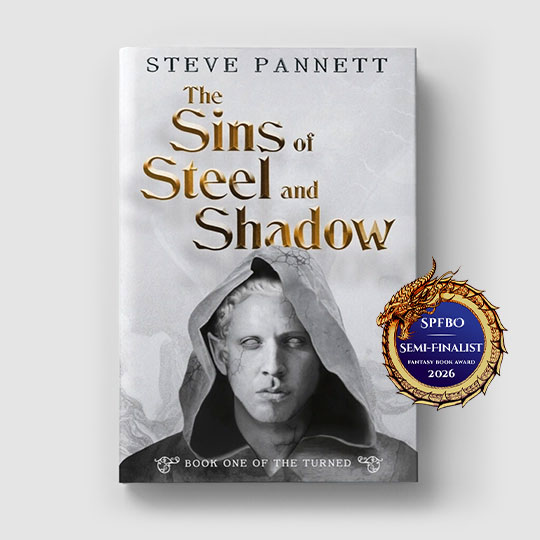
Book One of the TURNED
The Sins of Steel and Shadow
Hated and reviled by humans and vampyrs alike, every day for a Turned is a deadly struggle. But when Bail is offered the chance of a lifetime, there’s much more at stake than just his survival.
The Turned series is a fast-paced, character-led, gritty fantasy saga for fans of Joe Abercrombie or Scott Lynch.

Steve Pannett is an author and designer based in Yorkshire, UK.
He writes primarily in the fantasy genre, combining character-led storytelling with epic, gritty world-building to create dark tales with plenty of action and lots of twists along the way.
He has self-published multiple books and is active online.