Let me start by saying that writing and publishing are two very different things. The former is something that comes naturally to every author I’ve ever spoken to. The latter, though, can be a bit of an enigma. You’ve written your book, but now you want to share it with the world! So what’s the best way to get your book published and into the hands of eager readers? Traditional publishing (sometimes referred to as “trad” or “trad pub”)? Self-publishing (self-pub)? Or what about publishing through a small press? There are lots of routes into publishing your book, so here’s a quick guide to each of them:

Traditional publishing
Traditional publishing, or “trad” to use the shorthand, is—you guessed it—the more traditional way of getting your work reproduced and sold at scale. The model for this route is that a publisher will buy the rights to a manuscript—paying the author an advance—and then handle all production and distribution costs. The publisher will take a cut from every unit sold, and an author will receive royalty payments (usually once certain thresholds have been met). Here are the pros and cons of this route.
| Pros of traditional publishing | Cons of traditional publishing |
|---|---|
| You have less jobs to do The publisher will handle production and distribution, leaving you to focus on writing. Access to a wider distribution network or a team of people who can help to launch your book is a huge asset. Note that I said you’ll have less “jobs” and not less “work” — all forms of writing/publishing requires hard work! | You need a literary agent Not a bad thing in its own right (agents are great!) but it does mean an additional step you’ll need to complete. Traditional publishers will not deal directly with authors. You will need to gain representation from a literary agent first. |
| You take less financial risk You’re not paying for cover design, or marketing the book*, so you’re not out of pocket if the title doesn’t sell as well. | *You are expected to do some marketing Slightly controversially, more and more publishers expect the authors on their books to develop something of a personal brand. This makes you more marketable (and therefore less of a risk to them). This is not necessarily the case for all publishers, and applies more to mid-list authors who will be expected to help increase their own recognition in the market. |
| You get paid upfront This is your advance. The size of it, and what triggers each payment, will differ depending on your contract. | You don’t get as big a slice of the pie There are more people involved, so more people will need paying from the revenue that a book generates. The publisher, your agent, everyone involved in producing/marketing the book. The earnings per book are smaller for the author (but the chance of volume sales is higher). |
| You get royalties when your book “earns out” A book “earns out” when royalty money covers the initial advance (essentially repaying the publisher’s initial investment in you) — so you won’t get any royalties until this happens. But afterwards, you will receive a cut from every sale made. You will still get your advance, regardless. This is typically how it works, you will need to read your own contract in order to understand your specific situation. | The process moves slowly Traditional publishing is a slow-moving beast. Manuscripts are bought years in advance of publication, and you are at the mercy of all those involved. On the bright side, this gives you more time to write your next book! |
| You have a financial safety net Even if your book doesn’t “earn out” you shouldn’t need to pay the difference back to the publisher or reimburse your advance in any way. Always check your contract. | More pressure If your books are less successful than hoped, then your future work may not be picked up by publishers. You will also be working to other peoples’ deadlines, as you are now a part of someone else’s process. |
| You have more people fighting your corner Your agent and your publisher will fight for your success. They will do everything they can to ensure your books sell well, because now they have skin in the game! | Fewer rights All of the rights to your book are likely going to be owned by the publisher. That means they have control over signing future deals, including stuff like whether or not it can be adapted into TV/film or even a new format like an audiobook. Always check your contract. |

Small/indie press publishing
Small or independent (indie) publishing houses are typically classed as publishers outside of the “big five” publishing houses. These are Penguin Random House, HarperCollins, Simon & Schuster, Hachette, and Macmillan — each of them also has a huge number of imprints (smaller arms of their business that might focus on one particular genre/area of publishing). A small press is a publisher who is not affiliated with those organisations in any way.
It’s important to note that you might not need a literary agent in order to partner with a small press. However, you should do your due diligence and make sure that you fully understand any documents that you’re asked to sign. Among other things, an agent will help sort your contract, so if you’re doing this on your own you should know exactly what all of it means.
The model for working with an indie press is largely the same as working with a big five publisher (or one of their imprints), but here are the pros and cons.
| Pros of small/indie press publishing | Cons of small/indie press publishing |
|---|---|
| Incredibly niche If you write in a very specific sub-genre or area of special interest, partnering with the right small press should mean strong access to that market. | Incredibly niche As well as being beneficial, the fact that most small presses are very niche will also mean they don’t necessarily have as broad/deep a reach as the traditional publishers do. |
| You get an advance Like with trad publishing, you should still get an advance from an independent publishing house. The exact amount and payment triggers will vary depending on your contract. | The advance will probably be smaller Indie presses don’t have the same resources as large publishing houses, so your upfront payment will probably be smaller. |
| You get royalties when your book “earns out” As with traditional publishers, you should earn royalties on your book once those royalties have matched the initial advance. Always check your contract. | Fewer resources are available to you Smaller presses are, by definition, smaller than the big publishing houses. They will operate on leaner budgets, so there will likely be less marketing spend allocated to your book. |
| You will probably earn more per sale Once your book has “earned out” your royalty payments will likely be a higher percentage than if you’re signed to a traditional publishing house. This will vary from contract to contract. | You will need to do more jobs Although you’re sighed to a publisher, it’s highly likely that you’ll still need to contribute towards marketing your work in some capacity. Most production-side things should be covered (editing, cover design, production itself) but you will need to do more to promote the book in the market. |
| You will have more control Smaller publishers typically have closer relationships with the authors signed to them. There is more chance they will involve the authors in decisions like cover artwork or marketing opportunities. This is not to say that trad publishers don’t have good relationships with authors, and it will work on a case-by-case basis. | Fewer rights As with trad publisher contracts, it’s likely that an indie publisher will want to acquire more rights to your work. Always check your contract. |
It’s worth noting that a lot of small presses are geared towards academic publication. If you’re a fiction writer, particularly in broader genre fiction, then you’re more likely to find a viable route through traditional publishing or self-publishing.

Self-publishing (indie author)
Self-publishing is, as you’d probably expect from the name, a form of publishing whereby the author takes their own book to market. You have no agent representation, no one covering your production costs, no distribution network and no one—other than yourself—championing your books. It is, however, a viable route for many authors, if you’re prepared to do the work.
There are a few ways to self-publish your book, but two of the most common are through Amazon (Kindle Direct Publishing) or IngramSpark. For my own books, I publish through IngramSpark as opposed to Amazon. There are two reasons that I do this:
- I believe the print quality offered by IngramSpark is better than that offered by Amazon, but this is a subjective opinion
- IngramSpark offers “wide” distribution — which means that any titles I publish through their platform can/will be stocked by lots of retailers (including Amazon). By contrast, any books published through Amazon KDP will only be available for readers to buy through Amazon.
There are other self-publishing platforms out there, so I recommend doing your research on what you feel is best for you. Here are the pros and cons of self-publishing your books.
| Pros of self-publishing | Cons of self-publishing |
|---|---|
| You are your own boss You set the schedule, you decide what to write and when. You can change your mind as much as you want without breaking any contractual obligations (unless you have signed something elsewhere, obviously). | You are responsible for everything Writing, production, distribution, marketing. It’s all on you. Yes, you can pay for experts to help (editors, cover designers, marketeers etc etc) but all of that cost will be incurred by you alone. |
| You keep more of the money that your book earns Aside from the production costs, money from your sales go directly to you. Out of all of the routes, self-publishing is likely going to provide the largest percentage of a sale to you, the author. | You take all of the financial risk Paying for editors, cover designers (avoiding AI scam artists), event spaces (and all of the stock/ancilliary stuff you need for live events) can quickly amount to a big bill. You should be frugal, but don’t expect to be able to make a success of it without investing something in yourself. Just don’t gamble with your financial security. |
| Print-on-demand means no massive overheads Most self-publishing (for hard copies of books) uses a system called print-on-demand. This means copies of your paperback/hardback books are only printed when a customer orders one. It means you don’t have to pay upfront for stockpiling, unless you plan on selling copies at in-person events. | Returns can be costly Depending on your agreement with retailers, they can return unsold books to you. This can actually end up costing you money, as you will need to cover the postage or destruction costs to have them returned or destroyed. With IngramSpark, you can set your books to not allow returns, but retailers are much less likely to buy your books if they run the risk of being left with unsold copies. Choose your settings wisely and be ready to cover the cost of dealing with returns. |
| You can move faster than publishing houses Self-publishing a book can happen as soon as the book is ready. This means you can organise your release schedule in a much more timely fashion than larger organisations can. Just remember that speed doesn’t make up for a lack of quality — just because you can hit publish, doesn’t necessarily mean that you should! | You are a target for scammers Lots of writers dream of being published, which makes them vulnerable to scams. Expect to receive more than your fair share of baited hooks or bad actors promising you the moon on a stick. Stay vigilant and if it sounds too good to be true then it probably is! |
| You can try new things Self-publishing, and the creative control that it brings, means that you can experiment with your writing. You aren’t beholden to any contractual obligations and so are free to produce whatever you want. Just remember that even multi-genre authors tend to have common threads across their style, because it’s more recognisable to their audiences. | It’s a crowded market Because self-publishing is so accessible, millions of new books are released each year. Your book will need to be its best possible self in order to stand out and make an impact. |
| It’s rewarding to see the fruits of your labour Self-publishing likely means building from scratch, and probably on a shoestring budget. So, when you start to see the shoots of success you will feel all the better for it, knowing that it was you who made it happen. | It’s exhausting I won’t sugercoat this. Self-publishing your own books is a monumental amount of work. You need to really love writing if you want to make a success of this, because you will also need to be the salesperson, PR hype-person and marketing team for your books. There are no cheat codes and no shortcuts. |

My personal experience
I am a self-published author, and I chose that route from the jump because I felt that it would be best for me. However, it’s important to understand the nuance behind my decision-making. Here are some of the reasons I picked self-publishing as my route to market:
- I’d been financially independent for years — which means that I wasn’t gambling on the success of my writing career. My primary income came from a professional career developed over 15+ years. This meant that I could comfortably invest in self-publishing without jeopardising my standard of living or compromising my family’s security.
- I had requisite skills before I started — I understand marketing, so I knew how to run that side of things from the start (although I’ve still learned plenty along the way!) My biggest learning curve came from understanding production and distribution agreements (see my note above on managing returns).
- I can save money where others can’t — As well as being an author, I’m also a trained graphic designer (see that 15+ year career I was talking about) which means that I’m able to publish using my own cover designs. This is a hurdle that I see a lot of new authors fall at, because cover design is an incredibly important component of a book, and they’re nervous about investing in it and instead opt for a DIY approach. More often than not this will fail, because the resulting cover either looks DIY, or they use cover professional-grade cover artwork but apply their own design/typography. Worse still, some opt for AI-designed covers. You should never do this. Among other reasons (i.e. you should support legitimate, human artists) many readers will—quite rightly—assume that your book is also written by AI.
- I’m in this for the long game — This isn’t necessarily specific to me, but I went into self-publishing fully aware that it might not become my primary source of income for years—maybe even decades, and potentially never! Earning money was never my immediate goal, though I still treat it as a business in its own right.

Final note on publishing: things to look out for
As well as these publishing approaches, there are also a few other things that you should keep an eye out for on your publishing journey. In no particular order:
Taxes
Depending on where you live and how your publishing route is set up, you will need to make sure that your income (and any relevant taxation) is properly accounted for. Treat this with the care and attention it deserves to avoid being stung with a hefty bill, or even falling foul of the law.
Don’t be a dick
This is applicable to any part of life (not just publishing) but you should know that the industry is very small. And online communities are often very tight-knit. As such, if you behave in a way that’s unacceptable, word will travel. Where you can, pay it forward and just…don’t be a dick.
Understand different spaces
There are lots of different communities within the literary space. As a published author, you will need to understand that some of those spaces simply aren’t for you. The best example of this I can give is book reviews. Reviews of your book will feel very personal, but they are not for you. Once you hit publish, readers are allowed to have (and air) their opinion of your creative work. You might disagree with them, but your best recourse is to simply stay out of it.
Look out for scams
I mentioned this in the self-publishing section, but just be aware that the publishing industry is a breeding-ground for scams. Common scams include people posing as fake literary agents or pretending to represent large publishing houses. Others will offer to promote your book to wide audiences or promise over-inflated marketing success. The general rules here are:
- Do your homework. Check email or web addresses to verify legitimacy. If you need to, find the purported company/person and call them to check the comms are legit.
- Don’t pay anyone anything unless you’re absolutely sure.
- You should never have to pay a press to publish your work, or an agent to represent you. If it feels dodgy, it probably is.
- If it sounds too good to be true…it probably is. Scammers prey on dreamers, so they will promise the world in order to get you to part with time or money.
Don’t use AI
Artificial Intelligence is a poison to the world of writing. I actually think it’s a poison to the world in general, but that’s for another post. If you’re interested, my full policy on AI in writing here (spoiler: I’m against it) but, for now, let me just say that if you try to use AI (either to write, to design your cover art, or in your marketing) you will likely be ostracised and/or black-listed, and rightly so. If you try to hide your use of AI you will be found out, and it will go even worse.
This is because you’re trying to short-cut something that needs time and effort in order for it to work. AI simply cannot replicate a lived human experience, and that is what you need in order to write and publish a successful book.
Don’t let comparison be the thief of joy
There are lots of authors in the world. All of us dream of making a success of it, and we will invariably see others having more joy there than we are. Don’t compare yourself to others, just keep your eye on the prize and most importantly…
Enjoy the journey!
I’m yet to meet an author who hasn’t had a rollercoaster ride when it comes to their publishing journey! So make sure you celebrate the wins (no matter how small you think they are) and keep the love of this most magical craft at the heart of everything that you do.
📚✌🏻SP
Share this post
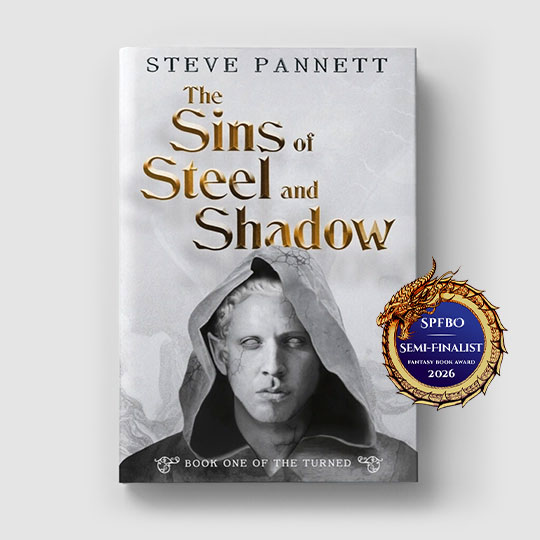
Book One of the TURNED
The Sins of Steel and Shadow
Hated and reviled by humans and vampyrs alike, every day for a Turned is a deadly struggle. But when Bail is offered the chance of a lifetime, there’s much more at stake than just his survival.
The Turned series is a fast-paced, character-led, gritty fantasy saga for fans of Joe Abercrombie or Scott Lynch.

Steve Pannett is an author and designer based in Yorkshire, UK.
He writes primarily in the fantasy genre, combining character-led storytelling with epic, gritty world-building to create dark tales with plenty of action and lots of twists along the way.
He has self-published multiple books and is active online.