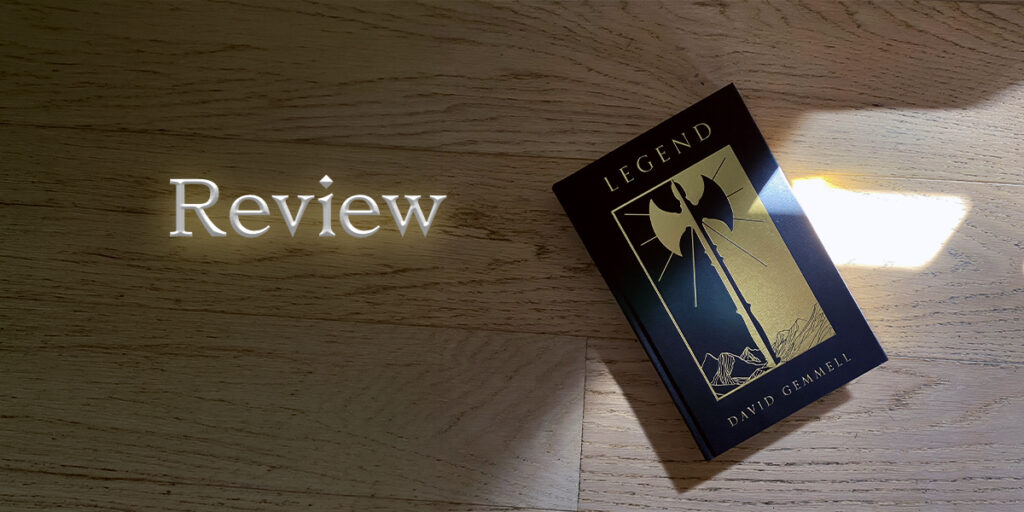
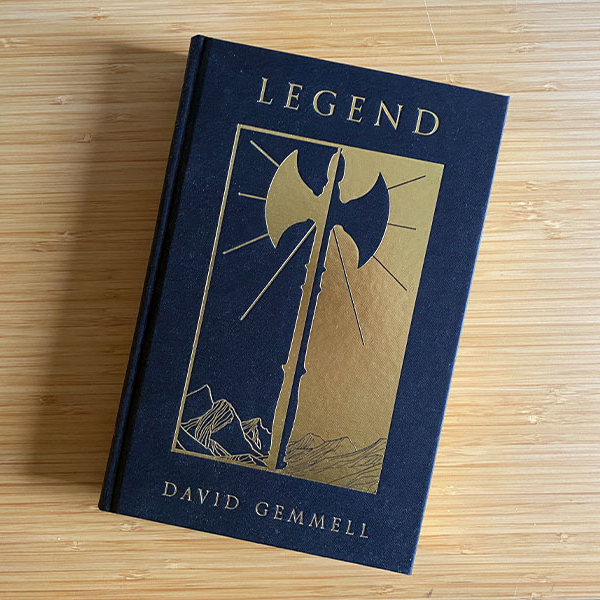
TLDR; there’s a reason this book gets cited so much as a solid entry point into fantasy reading. But it’s actually so much more than that. It’s one of the finest heroic fantasy novels ever published. Here’s my review of David Gemmell’s 1984 debut novel, Legend.
A bit of context
Legend was Gemmell’s published debut, but like most authors it wasn’t his first foray into writing. He admitted to attempting to get published in the 1970s but acknowledged that his first attempt was “a book so bad that it could curdle milk at 50 paces”.
Then, in the mid-seventies he was diagnosed with what was expected to be terminal cancer. The experience led him to penning the first draft of a story that he called The Siege of Dros Delnoch (Dros Delnoch being the fortress where most of the story takes place). The draft was completed in just two weeks, and served as a metaphor for Gemmell’s last stand against a terrible foe.
That diagnosis turned out to be a misdiagnosis, and the manuscript got shelved until a friend of Gemmell’s read it and encouraged him to revisit and tighten it up a bit, before submitting it to prospective publishers. He was successful in doing this, with the manuscript taking on the new title of Legend.
Cue a storied career as one of Britain’s finest writers of heroic fantasy, during which Gemmell published over 30 bestsellers.
The premise of Legend
The context above is important because it will make you appreciate the story even more than I think you should. The fact that the first draft was written in just a fortnight means the story is lean, but not to the point of emaciation. It means it is fast-paced, but without ever feeling frantic. Most of all though, it is written with that most important ingredient for any fantasy book: heart.
Legend is our first introduction to the people of the Drenai, a civilisation under threat from the conjoined forces of many nomadic tribes (the Nadir). The easiest through-line to draw between the Nadir and real history is between Genghis Khan and his ancient Mongolian horde. A single, unifying warlord brings a multitude of warring tribes together and leads them on a campaign to conquer the known world.
The Drenai, then, are in a spot of trouble. Under the Nadir’s own Great Khan (a character called Ulric) their very existence is threatened. They do, however, have three things that they can pin their hopes for survival on.
The first is the fortress of Dros Delnoch. A seven-walled, step-like megastructure carved into a crucial mountain pass. It is, to all intents and purposes, the only thing that will confine the Nadir horde to the steppes they call home, and stop them from rampaging across the world.
The second is the Earl of Bronze. An important mantle in Drenai history, but one that has flattered to deceive when we join the story. The strength of the Drenai, it seems, is failing.
The third is an old man. A warrior, well past his best years and a veritable legend among the Drenai people. The Nadir call him Deathwalker. The Ventrians call him the Captain of the Axe. The Drenai themselves have a much simpler name for him.
Druss the Legend.
The book opens with Death itself whispering a bargain in Druss’ ear. Living in solitude, the reaper tells Druss that if he remains in his mountain cabin he will live for decades to come. But that if he travels to Dros Delnoch to defend the Drenai, he will die there.
Druss, being Druss, makes his choice, and journeys to the Dros to make his final stand.
The review
As you’ve probably already gathered, I highly recommend this book. And here are all the reasons why.
Legend captures the true essence of what makes heroic fantasy great, as a sub-genre of fantasy. It has magic elements, yes, but the real weight of the story comes from the characters themselves. The choices they make and the paths they walk are what makes this story epic. Every individual character faces their own intimate, highly personal battle (usually with themselves) that feels mirrored by the larger conflict in the story.
Legend examines courage and cowardice in a cast full of warriors, without ever leaning on the crutch of “violence = heroic by default”. Such a notion is antithetical to all of Gemmell’s writing, which regularly revisits the topic of what true courage really is. I would even go so far as to say that Gemmell’s books, and Legend in particular, make for brilliant reading for boys or young men who are vulnerable to the poison of the modern-day “manosphere”. They epitomise the tension between doing categorical “good” and standing up for what’s right (i.e. if using violence is wrong, should you ever use it to defend people more vulnerable than you?)
Gemmell’s writing often gets accused of seeing morality as too dichotomic, but I disagree wholeheartedly. The whole point of his books is that viewing good/evil through that overly simplistic lens is futile. Each of us has to accept that there is nuance to our words and actions, but that we should always strive to stand in the light. It is this constant struggle that makes Gemmell’s heroes so compelling.
And then there’s the story in Legend itself. A desperate final siege in an epically-constructed fortress, the stakes of which could not be higher. Battle sequences interspersed with threats from the shadows. Magic warrior priests and nefarious, demon-summoning shaman. Legend covers a lot of ground, but it never once feels erratic or ill-thought through. Each scene does what every good book should do…it keeps you eagerly turning the page.
It’s true that some of the writing hasn’t aged brilliantly, but I would say that it’s nowhere near problematic. It’s certainly nothing compared to some other books of the same era, and will likely not even register for most readers.
And yes, some of Gemmell’s dialogue is a bit clunky at times, and yes, some of his characters do feel a little wooden, but these are nit-picks at best. Legend is an epic tale of heroic fantasy, with both an iconic setting (much of the book takes place in and around the seven-walls of Dros Delnoch) and an iconic cast of characters. A cast that is led by one of the most iconic characters in all of fantasy in Druss the Legend.
In the midst of an empire’s final stand—among the bloodshed and the violence—there is redemption, there is courage, and there is even love. There is heartbreak aplenty, not least of all for the reader, and this book deserves its place in the pantheon of heroic fantasy books.
📚✌🏻SP
Share this post
Book One of the TURNED
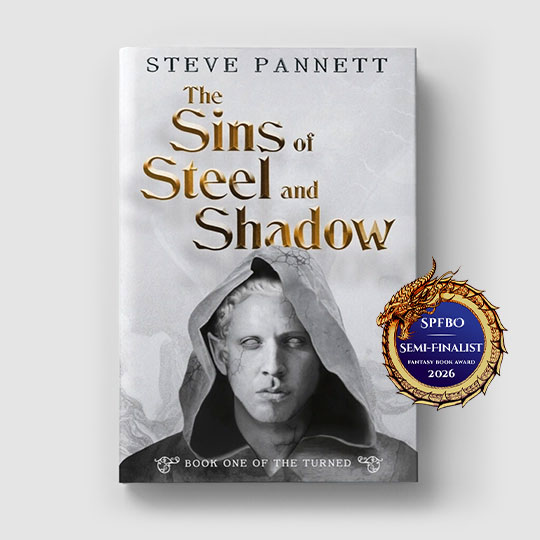
The Sins of Steel and Shadow
Hated and reviled by humans and vampyrs alike, every day for a Turned is a deadly struggle. But when Bail is offered the chance of a lifetime, there’s much more at stake than just his survival.
The Turned series is a fast-paced, character-led, gritty fantasy saga for fans of Joe Abercrombie or Scott Lynch.

Steve Pannett is an author and designer based in Yorkshire, UK.
He writes primarily in the fantasy genre, combining character-led storytelling with epic, gritty world-building to create dark tales with plenty of action and lots of twists along the way.
He has self-published multiple books and is active online.