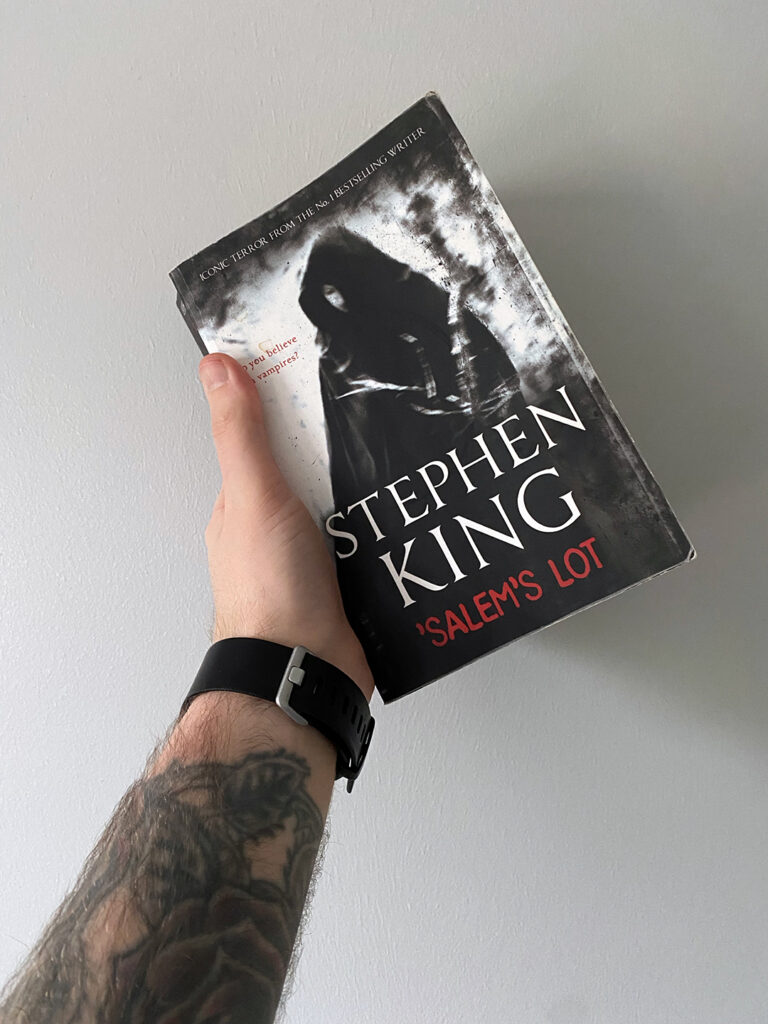
I’ve written a lot about Stephen King on this blog, including what I believe to be the best five books that he’s written (so far, at least). This book didn’t actually feature on that list, but that’s probably only down to the fact that there are so many gems and I was ruthless in limiting it to just five titles. What I will say is this: if pure horror is what you’re looking for in a book, ‘Salem’s Lot is for you. Here’s my full review:
The review
I know this is a bit of a trite remark to make, but ‘Salem’s Lot feels very much like a direct evolution of Bram Stoker’s Dracula. Or, if you want to go a little bit further back—the book that inspired Stoker, John Polidori’s The Vampyre (which, coincidentally, came out of the same short story competition—set by Lord Byron—that also produced Frankenstein; or, The Modern Prometheus by Mary Shelley).
What I mean by that is that, quite simply, this is a pretty straight-shooting vampire horror novel. The main antagonist—one Kurt Barlow—probably conjures the exact image of what a vampire looks and sounds like, if you were only to explain “the bad guy is a vampire”. King himself has freely admitted that the inspiration for the story was simply positing the question “what if Dracula came back to the twentieth century? To America?”
But there is so much more to this book than just a standard re-telling of a vampire story. It is a masterclass in setting stakes and building tension, and—despite not being short, at over 700 pages in the paperback edition—it’s a fast-paced read. One of those books that will steal so much of your attention that, before you know it, you’ll look over at the clock and realise it’s nearly 2am.
The premise itself is, as I’ve already pointed out, pretty straight-forward (and fits King’s usual MO). A writer (told you it fit the MO) returns to his sleepy hometown in order to pen his next novel. He ingratiates himself back into the town, starting friendships and engaging in a romantic relationship, too. Only one part of his return unsettles him, and it’s also the subject of his new book. The Marsten House.
As a child, our protagonist (Ben Mears) had a terrifying and ghostly experience with the house. As an adult, he learns that it’s now owned by two business partners; Richard Straker and the never-seen Austrian immigrant, Kurt Barlow. Straker, is in fact, Barlow’s familiar. Barlow, as I’ve already mentioned, is an ancient vampire.
“The town kept its secrets, and the Marsten House brooded over it like a ruined king.”
— ‘Salem’s Lot
Cue strange happenings around “the Lot” — children disappear or are found dead, closely followed by a tranche of adult victims, too. It quickly becomes apparent that Barlow is—as expected—running the Dracula playbook of trying to spread his vampiric curse as much as possible (while also indulging his unslakable thirst for blood).
So, rural smalltown beset by plague of vampires — it’s hardly original (even for 1975, when it was first published) but if this ticks your boxes then it is such a worthwhile read. Ben is more likeable than a lot of King’s protagonists, and the little team he assembles to fight the vampire menace are fleshed-out enough for you to care when they’re in danger—which, as you’d expect, is often.
Most notable of these other characters is Father Callahan, an alcoholic Catholic priest who lives in ‘Salem’s Lot. The character’s biggest moment comes during a one-on-one confrontation with the lead vampire, Barlow. It is an incredibly charged scene and the outcome is both devastating and (objectively, from a writer’s standpoint) brilliant. Without spoiling too much, Callahan also goes on to feature in King’s series The Dark Tower — and he carries the weight of this scene with him.
Linguistically I think King has more fun in this story, too. That’s not to say his other work is less colourful, or less playful or clever with language, but it feels like he fully embraced the gothic nature of the subject matter. Steeped heavily in religious themes, without ever become bogged down by them; the book strikes a comfortable balance between being set in a contemporary environment and taking on ancient, archaic content. You can go from reading about smalltown 1970s gossip to discussions about the immortal soul, and not once does it ever feel jarring. If anything, it complements.
I should also note that this book is not for the squeamish. It is gory and violent, and—as I’ve already mentioned—it doesn’t pull its punches when it comes to who falls victim to a vampire’s hunger. If you know Stephen King books then this shouldn’t come as a surprise, but if you’re put-off by dark, heavy themes and often visceral, graphic writing—I’d steer clear of ‘Salem’s Lot.
That being said, I don’t feel the book ever becomes gratuitous. In other books, I think King has sometimes wobbled when walking the line between necessary and unnecessary depictions in his work — but this is not one of them. ‘Salem’s Lot is a well-crafted, pureplay horror novel that hits all the right notes when it comes to a good vampire story. It’s a modern gothic masterpiece.
📚✌🏻SP
Share this post
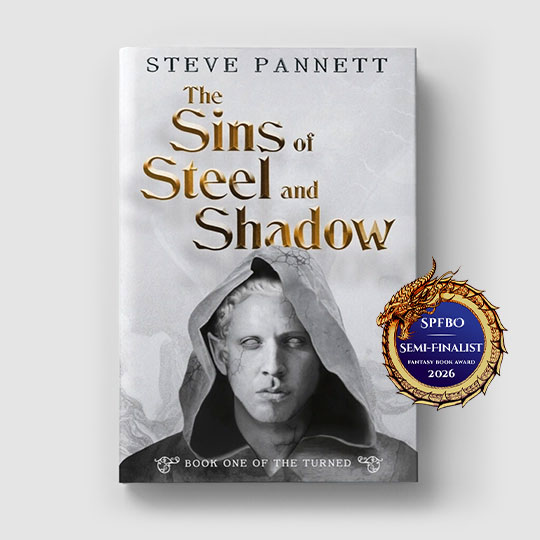
Book One of the TURNED
The Sins of Steel and Shadow
Hated and reviled by humans and vampyrs alike, every day for a Turned is a deadly struggle. But when Bail is offered the chance of a lifetime, there’s much more at stake than just his survival.
The Turned series is a fast-paced, character-led, gritty fantasy saga for fans of Joe Abercrombie or Scott Lynch.

Steve Pannett is an author and designer based in Yorkshire, UK.
He writes primarily in the fantasy genre, combining character-led storytelling with epic, gritty world-building to create dark tales with plenty of action and lots of twists along the way.
He has self-published multiple books and is active online.