It’s always been tricky to define certain sub-genres of fantasy, but grimdark seems to be one of the hardest to pin down. I think, for most people, the distinction between it and other subsets of the fantasy landscape—such as high/epic fantasy—is pretty clear. Grimdark is where you go if you want to see the bleaker sides of a fantasy story. If you want to read in the shadows, if you will.
But, like many shadows, there are gradients to consider. Not every one of them is the deepest, darkness blackness. They’re not so much shades of grey as they are tints of the darkness itself, which is why I personally subscribe to the following system of categorisation:
Steve Pannett’s “scale of darkness”
- Gritty fantasy = Fantasy with an edge and some bite. Unafraid of violence, or bleak topics in general, but ultimately not as nihilist as other work might be. More of an examination of how characters struggle in broken systems and are faced with tough decisions.
- Dark fantasy = Almost adjacent to “gritty” fantasy, but with more despair-laden vibes. Trauma and psychological damage feel more at play here, though physical violence is still very present. Arguably more “goth” or supernatural in tone than both gritty and grimdark works.
- Grimdark fantasy = Can often be labelled as “edge-lordy” (in some cases, rightly so) but it’s definitely competitively bleak. Grimdark books offer little by way of hope or heroism (even the anti-heroic kind) and serve up everything as raw as it can be.
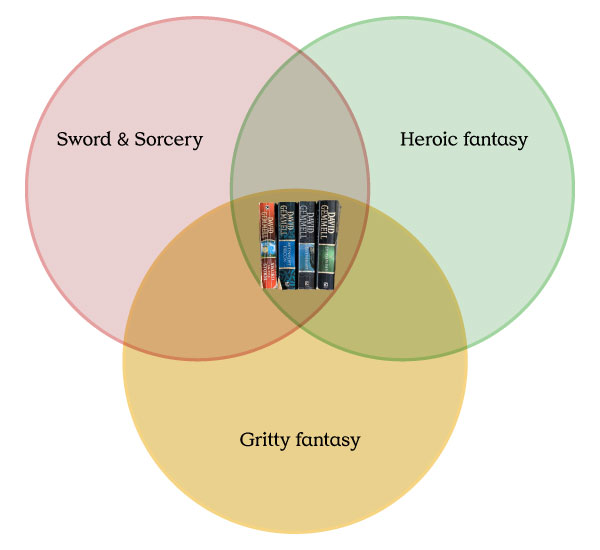
So, those are my definitions. And it’s important to note that I also don’t believe in categorising any book in a single genre or sub-genre. I think there is nuance to this, in that most stories will render a Venn diagram consisting of three—if not more—sub-genres.
For example, one of my favourite authors (and a huge inspiration for my own writing) is David Gemmell. Most of his books are labelled as Sword & Sorcery or heroic fantasy. While those are decent, zoomed-out viewpoints, they don’t paint the full picture. I could comfortably argue that gritty fantasy would get a mention in most, if not all of his works, alongside either S&S, heroic fantasy, or even a more uniquely identifying category (such as Celtic fantasy, in the case of his Rigante series.)
Why does any of this matter?
The simple truth is it might not matter, this is just my musings on the subject. But I do think it could be useful in signposting readers to the type of books they love the most. My “scale of darkness” should provide a bit of nuance where simple light/dark fantasy labels can’t.
This is especially important when you consider that one of the grimdark genres biggest contributors, Joe Abercrombie, has himself gone on record that the label is unhelpful. The author has been open about how he feels “it reduces nuanced, character-driven storytelling into a simplistic caricature that revels in edge-lord nihilism and violence for its own sake.”
Joe Abercrombie even goes so far as to retain his “LordGrimdark” tag across social media platforms in order to poke fun at critics who represent his books as just that (edge-lordy violence for the sake of violence).
This, then, is why I’m keen to circulate my “scale of darkness” — to help readers better understand what they might be getting themselves into. For my own writing, the potential mantle of grimdark never sat well with me, because of the kind of baggage that Joe Abercrombie has previously described. I have always felt that gritty fantasy feels like a better summation of my own writing style. Something that examines the difficulties of characters grappling with heroism and villainous behaviour, self-sacrifice, and their willingness to do terrible things for seemingly positive reasons. Something more than the pure, unmitigated despair that is suggested—perhaps incorrectly—by the label of grimdark.
It’s also important to note that I’m not trying to shit on grimdark books, here. There are plenty of authors, and plenty of readers, who love deep-diving into that end of the scale and fully embrace the label. I’d just like to see a system of categorisation that isn’t quite as binary as the cut-off into darkness feels, right now.
📚✌🏻SP
Share this post
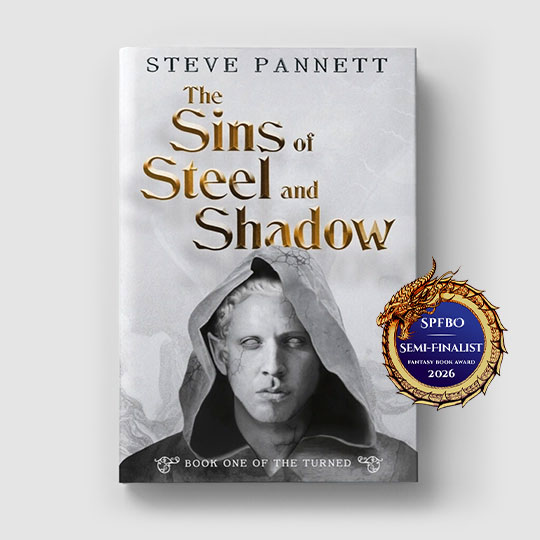
Book One of the TURNED
The Sins of Steel and Shadow
Hated and reviled by humans and vampyrs alike, every day for a Turned is a deadly struggle. But when Bail is offered the chance of a lifetime, there’s much more at stake than just his survival.
The Turned series is a fast-paced, character-led, gritty fantasy saga for fans of Joe Abercrombie or Scott Lynch.

Steve Pannett is an author and designer based in Yorkshire, UK.
He writes primarily in the fantasy genre, combining character-led storytelling with epic, gritty world-building to create dark tales with plenty of action and lots of twists along the way.
He has self-published multiple books and is active online.