Writing a book, as any author worth their salt will tell you, is no easy feat. But I do believe there’s a way you can make the process easier, for both yourself and your intended creative output. This is my step-by-step guide to writing a book.
Let me start by just caveating this article with a very important disclaimer: this is my process. It works for me and I’ve refined it (and will continue to refine it) over the course of writing 20+ novels (and actually publishing two books—with a third on the way—at the time of writing). That does not mean this is the only way anyone should write, ever. It’s merely a framework that I wish I’d had, back when I first started my journey as a self-published author in earnest.
This article also only covers my writing process. Actually publishing, and then—shudder—marketing your book(s) as an author, are two different beasts entirely. They are deeply connected as part of a wider approach, but if I tried to tackle them here then this article would end up being a novel itself! Which is funny, because if it did, this is how I would tackle writing it…
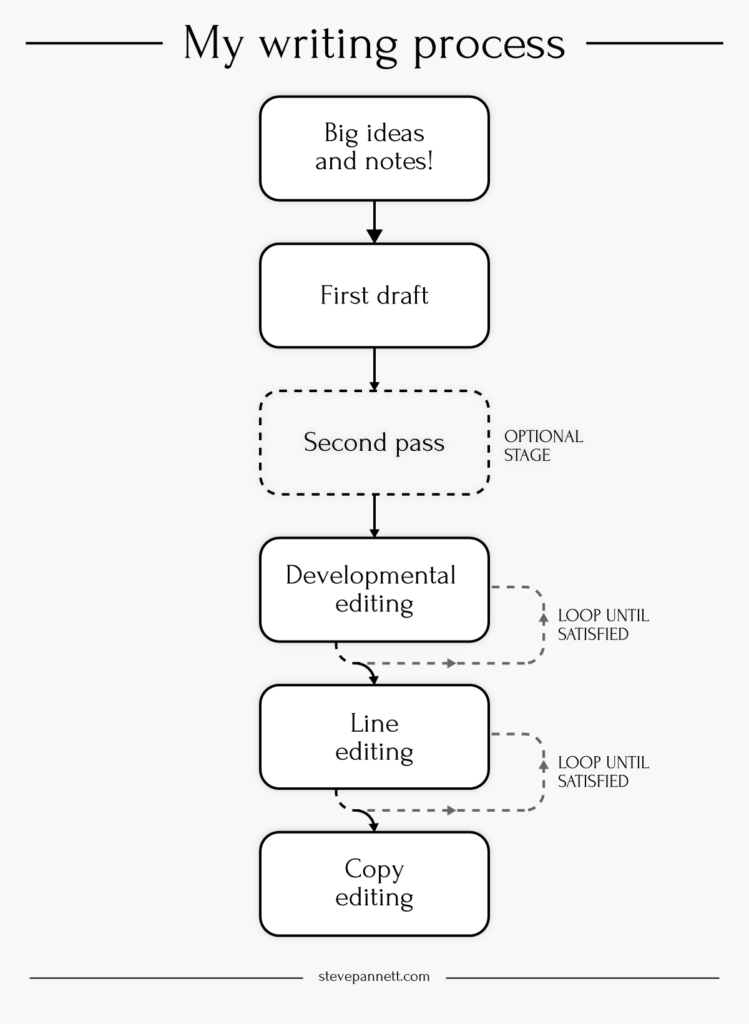

First draft
Seems pretty reasonable that we’d start with writing a first draft. Of course, this is typically the bit that authors get asked the most about. “Where do you get your ideas from?” is such a widely-accepted question that most authors I know have a fairly well-rehearsed response to it.
I won’t bore you with my own answer to that question. The simple fact is, if you’re reading this then you’re clearly a creative writer—so you already know where your own ideas come from. Observation, pontification, an inexplicable bolt-from-the-blue…it hardly matters, really.
What does matter is that you write it down.
You can plan, you can fly-by-the-seat-of-your-pants, you can do something in between (plantsing is my go-to approach) but the truth is you just need to write.
For me, the first draft is the most magical part of the entire process. It can be a stream of consciousness, where sometimes the story moves too fast for you to properly capture it in the right words. But that doesn’t matter in the first draft. At this stage, you’re only the conduit for the story. All that matters is you capture the essence of the story. The shape of it.
First draft top tips
- Don’t revisit it – For years (decades, actually) when I sat down to write, I would typically revisit the section that I’d finished in my previous session, before then moving on to writing the next bit. Of course, the latter part of this scenario rarely came to fruition, because I actually spent most of my time tinkering and tweaking what came before. This meant that I got bogged down and frustrated. Sometimes those manuscripts got abandoned after the third chapter. Sometimes I pushed through to 150k+ words, but then abandoned them because it felt joyless. The easy way for you to avoid this is to simply not revisit your first draft, as you’re writing it. Even if you’re certain that the previous section was a bit naff, just leave it alone. Move on. Write the thing.
- Stay the course – If you’re writing a lengthy piece (such as a novel) then the chances are that you will have a wobble or two as you’re writing the first draft. This is fairly normal, so you can push through it and continue working on your story. The one exception to this is if you find that you no longer enjoy writing it. If you are joyless in your writing, it will have both a negative impact on you and your readers will recognise it almost instantly. If that happens, figure out why and address it before continuing or…*deep breath*…mothball the project and move on to something that does bring you joy.
- This advice is shared from the perspective of a self-published author. I have no contractual obligations, deadlines or creative restrictions that I must adhere to. If you are traditionally-published (even with an indie press) then you obviously need to consider those obligations, rather than abandoning projects because they no longer make you happy. Maintaining the joy in my writing is part of the reason I love being self-published, because I can enshrine and protect that feeling forever.
- Don’t show anyone – The first draft is for you, and you alone. You don’t need feedback at this stage (unless you’re co-writing something, of course, in which case this entire article is probably a bit null-and-void) so you should resist the urge to share this story with anyone just yet.
- If you plan…don’t stick to it like glue – Always a controversial one, but I firmly believe that the best storytelling is a combination of art and science. Planning feels more scientific to me, and its great for making sure that you have the bones of a good story before you start to tell it. But if you then force your story to fit that predetermined mould…you risk sucking all the art from it. If you create a character, and breathe life into them over 500 pages, only to then have them do/say something that feels completely at odds with that experience—all because it’s necessary for your prepared design—then you will end up with a hollow feeling inside. Worse, your readers will, too.
That’s it, really. If you want to boil it down, the point of the first draft is to just get the story documented in its rawest form. Without that, you’ve got nothing. So, as my wife once sagely (and sternly) told me: just 👏 finish 👏 the 👏 damn 👏 story.
Second pass
Okay, so here’s some good news: the First Draft stage is probably the longest part of the writing process.
But here’s the bad news: it’s long in that writing 100k+ words (the generally accepted definition of a novel’s length) takes a while, depending on your writing speed — but it’s probably the shortest in terms of brainspace.
What do I mean by that? Well, your first draft will be new and exciting. It’s the freshest that story will ever be to your eyes and mind. From here on in, it will either age like a fine wine…or curdle like milk. Either way, the process takes time and patience.
The Second Pass is something that not all writers do. Personally, I like doing it because I feel it benefits my stories, and my own sanity. It is, essentially, exactly what it says on the tin: a second pass of the draft.
Second pass top tips
- Let it rest, first – Once I’ve finished a first draft, I like to leave the manuscript for about a month or so. I will either take a (well-earned) break or—more likely—throw myself into a different writing project. This could be writing a different manuscript, or blogging (like I am now!) Either way, I find that this creates a bit of necessary distance between you and your first draft, allowing you to return to it with a slightly fresher viewpoint.
- Again, if you’re on a deadline, you might not have this luxury. The only deadlines in self-publishing are your own.
- Try not to get bogged-down in the weeds – Don’t treat your second pass as the opportunity to craft every sentence or fix every typo. You are simply revisiting the story (with fresh eyes) in order to see if it feels right. If you, as a reader, enjoy spending time with the characters, can follow the plot, and feel that the pacing is good, then your second pass should be a pleasant experience.
- Do fix the big things – If, however, you find any problems with those big three tickets (characters, plot, pacing) then you might need to conduct some surgery. Again, I’m not talking keyhole-performed-by-robots surgery…I’m talking more old-school meat cleaver and bonesaw stuff. Make some rough edits to your draft until you’re confident that characters, plot and pacing are working in your favour.
Developmental editing
The reason some writers skip their own second pass is because they move on to what’s called developmental editing.
Developmental editing is a high-level, structural review of the novel. It focuses on the content, the characters, the organisation and the pacing of the book.
Sound familiar? Well, the reason I split these sections out is because a second pass is self-initiated. Developmental edits might be undertaken with some hired help. Developmental editors have the remit of assessing a novel at that high level, and then recommending changes based on their own insights. It is a professional skill, and not all writers are equipped to do it themselves, so hiring someone to support with it is a useful part of the process.
The rules here are pretty simple. In fact, there’s only really one rule: don’t be a dick.
Writing is subjective, and so is reading. Your developmental editor might recommend swathing changes that you, as the author, disagree with on a fundamental level. That doesn’t mean that their professional opinion is invalid, and nor does it mean that your opinion is wrong. All it means is that you disagree on how to make the book better and/or more marketable. Even if you choose to ignore the advice of your editor, please remember to always be kind, and conduct yourself with respect and integrity.
Line editing
Ok, so the key beats of your manuscript are now on point. Your novel is structurally sound and it works as a book. Are you ready to hit publish and get that mother off to press? No! No you are not. Sorrynotsorry.
This next step is actually the reason that a lot of books might start strongly, but gradually feel like they get worse as you progress. This is because page 5 was written with a fresh mind and a real zest for the project, whereas page 500 was written with aching fingers and a caffeine-addiction. And at no point did anyone think to revise the latter with the mindset of the former.
In short, the writer skipped line-editing.
What is line editing? Well, simply put, it’s the act of going through a manuscript, line-by-line, to ensure that each one is the strongest that it can possibly be, and is stylistically consistent with the rest of them.
Why is this important? Well, do you remember how your first draft was simply about writing the damn thing down? And do you remember how developmental editing only focused on the big-ticket items? Good, because neither of those stages addressed your writing on a molecular level. Line-editing is all about craft.
Line editing top tips
- Have a good reference point – You know your best writing style. Every author has a selection of passages that they’re particularly proud of. This is your voice, so use them as your north star when line-editing other passages. That doesn’t mean they all need to sound exactly alike—understanding cadence and variation is part of good writing—but it does give you a good barometer of what your writing sounds like.
- DIY or hire? Do either – Line editors also exist in a professional capacity, so you can always hire one to give your entire manuscript a once-over (and offer their suggestions for improvements) or you can line-edit yourself. There’s no right or wrong answer here, but personally I like line-editing because I feel that I’m the closest to my own work. It also gives me the freedom to take a creative risk or two.
- Start anywhere – Line-editing does not concern itself with the wider story. This is simply your chance to tighten up your writing. That means you don’t need to worry about the big things, you only need to worry about the specific scene/sentence that you’re editing. So, to this end, try line-editing chapters at random. Or maybe even start from the last chapter and work backwards. Just remember, this is all about improving your writing, line-by-line.
Copy editing
Oh wow, we’re so very nearly there! Your novel has a solid foundation, it’s cleared the big-ticket checks, and now every sentence is the strongest version of itself. But this final check is an important one!
Copy editing follows the same process as line editing, but its role is to review and correct the manuscript’s accuracy, clarity and consistency. This means adjusting grammar (which, IMO, means ensuring that it’s consistent). It means changing out words with nuanced meaning (which, in turn, impact what is actually happening in any given scene). And it means fixing typos.
On this last point: typos are devastating for any published novel, because they break the immersion of your reader. They are also viewed with scorn, and can immediately harm a whole book’s reputation (at least for some readers). However, it should be noted that I have happened upon typos in some of the best—and most famous—novels that I have ever read. Books that would have had teams of people reviewing and refining the text. It does not change my opinion of those books, it simply makes me realise the following:
To typo is to human, to write is divine.

Celebrate
This is a part of my process, and I believe it’s important enough to warrant an entry in this article.
You wrote a book! You should take a moment to celebrate that fact. Lots of people say that they want to write a book, but only around 3% actually start doing it—and even fewer actually finish. So you are in rare company, and should be proud of that.
And pride is an important part of this. If you’ve truly committed to creating the best possible story that you can, you should be proud. If you’ve not cut corners or (🤮) used AI to write for you in some kind of half-assed “get rich quick” scheme* then you should be proud. If you wrote for you, and not for some commercial target or homogenised cohort of marketable readers, you should be proud. You made art. That’s a wonderful feeling.
So take a moment. For me, that means pouring a glass of whisky and spending some quality time with my family. For you, well…far be it from me to tell you exactly how to celebrate writing a book. Just make sure that you do.
*AI “writers” are not writers. Nor will they ever get rich from churning out content via a glorified predictive-text machine. All they do is make it more difficult for actual writers by trying to con readers into buying their slop. It’s gross.
Other stages
This article has outlined my process for writing my novels. As I stated at the very top, this process is not the only process, and it may not work for everyone, either. I just wanted to share my own experiences as best I could, in case I should happen upon a kindred spirit who is just starting out on their writing journey, and is looking for a little advice.
It’s also non-exhaustive. There are various other stage-gates I could’ve included, but chose not to for the purpose of brevity. Instead, I’ll summarise these other stages (or sub-stages) as best I can, below:
- Alpha reader(s) – The first person(s) to read your novel and offer feedback. For lots of writers, this is a trusted friend or partner, as opposed to a professional editor. For me, this is my wife. She is both a supporter of my writing and a brutally honest critic, which is just about the best kind of first reader you can ask for. Alpha readers can be introduced at any stage, but it’s probably best to include them as part of your process before you seek any professional editing.
- Beta readers – A cohort of trusted voices who will, like your alpha reader(s), offer their thoughts on where your story could be improved. Their feedback can help shape your editing decisions, and I find it’s best to look for recurring notes or patterns (i.e. lots of your beta readers feel that “character X feels underdeveloped”) because it suggests a genuine weakness in the story, rather than the personal preference of any given reader. Again, I’d recommend working with beta readers ahead of any more comprehensive attempts to edit—though you could also lean on them after your developmental editing has finished.
- Advanced Reader Copies – Advanced Reader Copies (ARCs) should not be considered part of your writing process. Instead they are a marketing tool. You might send ARCs out to bloggers, reviewers or relevant publications in the hope that they might read and then review your book ahead of its publishing date. This should be viewed as separate to your writing, as your book should be completely finished by the time ARCs are released. Also, please note that you should never expect a review from your ARC recipients. Yes, you send these copies free-of-charge (which means you incur a cost) but that is not a guarantee you will get anything out of it. The “don’t be a dick” rule applies here…and everywhere, for that matter. Sidenote: don’t ever pay for reviews, and ignore anyone who offers a review in exchange for money.
- Sensitivity readers – These are a part of your writing. Or they can be, anyway. A sensitivity reader is someone who will review your story through the lens of looking out for offensive content, stereotypes, bias or an inaccurate depiction of culture. They will likely be a specialist in their area, and it’s important to work with them if you’re writing about topics that require…you guessed it…sensitivity. This doesn’t mean you should self-censor, or avoid hard-hitting subjects in your writing, it just stops you from making mistakes in your writing that you might not otherwise have seen. Stuff that might cause offence to some readers. Think of sensitivity readers as specialised beta readers.
- SMEs – Subject Matter Experts are similar to sensitivity readers, but they’ll be checking for accuracy within their specialised field. If you’re writing a historical fiction, for example, they’ll be able to tell you that the clothing your characters are wearing wasn’t actually invented until a century later—or that the weapons they’re using fell out of favour a century before. Again, these are specialised beta readers that not every book will need, but they are available.
In conclusion
Writing is always a personal journey, and while I don’t believe there is necessarily a right or wrong way of doing it, the process I’ve outlined above works well for me. In fact, it’s something that I wish I had twenty years earlier on my own journey, as I think it would’ve helped me write more, and write better.
I hope you find it useful, and if you have any top tips from your own writing process then I’d love to hear them!
📚✌🏻SP
Share this post
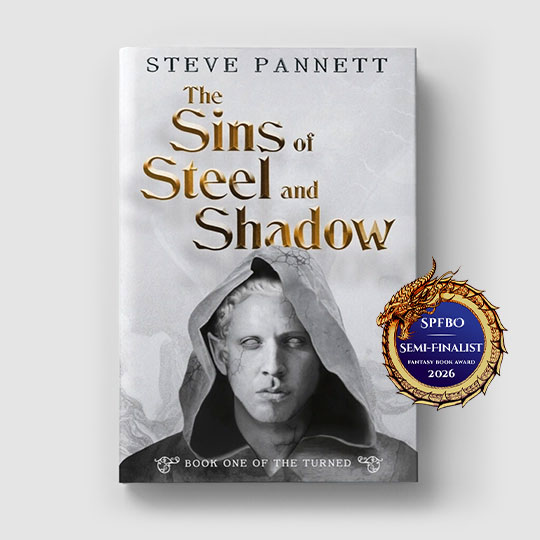
Book One of the TURNED
The Sins of Steel and Shadow
Hated and reviled by humans and vampyrs alike, every day for a Turned is a deadly struggle. But when Bail is offered the chance of a lifetime, there’s much more at stake than just his survival.
The Turned series is a fast-paced, character-led, gritty fantasy saga for fans of Joe Abercrombie or Scott Lynch.

Steve Pannett is an author and designer based in Yorkshire, UK.
He writes primarily in the fantasy genre, combining character-led storytelling with epic, gritty world-building to create dark tales with plenty of action and lots of twists along the way.
He has self-published multiple books and is active online.